Signature Line and Signature Block: What Belongs Where
What belongs on a signature line, what a signature block must contain, and how signing in a representative capacity keeps personal liability off the signer.
Sign a document and check the record yourself.
Start nowThe four characters that decide who is on the hook
Everyone copies the signature block from the last contract. Almost nobody knows what the parts do.
That is usually harmless. Then one day a supplier is not paid, the company has no money left, and the supplier's lawyer looks at the bottom of page nine to see exactly who signed. If the block says only a name above a line, the person who wrote that name has a problem.
Two letters and a colon prevent it. By: means the person is signing as an agent of the entity named above. Without it, and without the entity named, a court has to work out whether the signer meant to bind a company or themselves.
This guide covers what a signature line is, what belongs in a signature block, what By, Name, Title and Its mean, and the rule in the Uniform Commercial Code that decides whether a representative walks away clean.
A contract does not become void because the signature block is formatted badly. Offer, acceptance, consideration and intent decide validity. What a defective block creates is a different and more expensive fight: an argument about who exactly is bound.
Signature line, signature block, attestation clause
Three terms get used interchangeably and mean different things.
Signature line. The line itself. The place where the pen goes, or where the electronic signature is dropped. That is all it is.
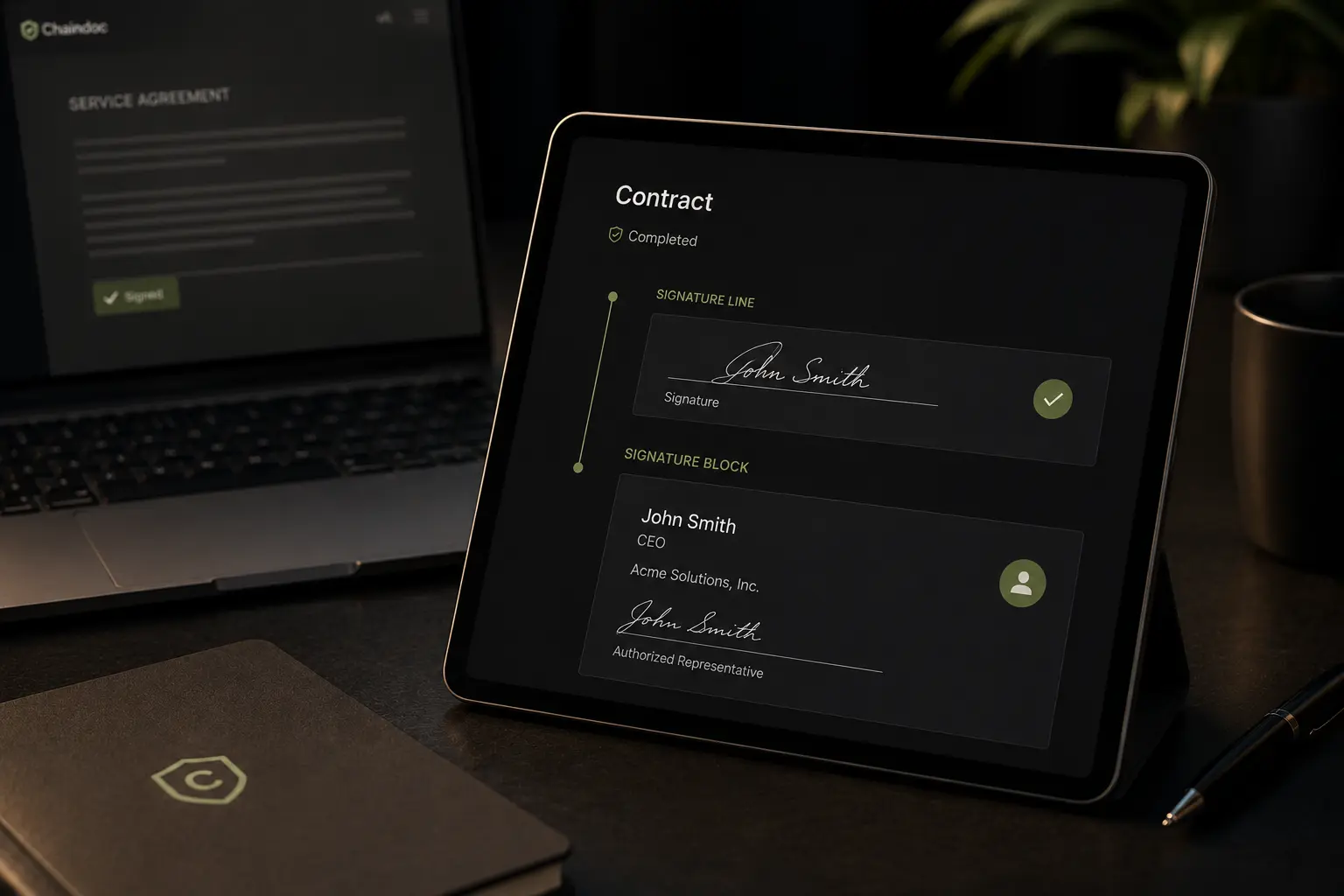
Signature block. The whole structure around the line: the party's legal name, the line, the printed name, the title, the date. The block is what tells a reader who is signing and in what capacity.
Attestation clause. The sentence that introduces the blocks, usually something like "IN WITNESS WHEREOF, the parties have executed this Agreement as of the date first written above." It does no legal work on its own in most commercial contracts, but it marks where the operative text ends.
The hierarchy matters when someone says the signature line is wrong. Nine times out of ten they mean the block. The line is a line.
What goes in a signature block
A complete block has five elements and they go in this order:
- 1.The party's full legal name. Not the trading name, not the brand. If the entity is Northgate Logistics LLC, the block says Northgate Logistics LLC, not Northgate.
- 2.The signature line, preceded by By:.
- 3.The printed name of the human being signing.
- 4.The title that person holds.
- 5.The date of signature.
Many drafters add the entity type and state of formation on the first line, especially in US practice: "Northgate Logistics LLC, a Delaware limited liability company." That is not required, and it is useful, because it removes any doubt about which of two similarly named entities is on the contract.
What does not belong in the block: job descriptions, department names, phone numbers, the sort of thing that migrates in from email footers. A signature block is not an email signature, and mixing the two is how the legal name ends up missing.
What By, Name, Title and Its actually mean
These four labels are copied constantly and explained almost never.
By: signals agency. It says the signature that follows is being made on behalf of the entity named above, not by the human being as an individual. It is the single most important element in the block, and it is the one people delete when they are tidying up a template.
Name: exists because signatures are illegible. A court reading a scrawl needs to know whose scrawl it is, and the printed name supplies that. It also matters years later, when nobody at either company remembers who was in that role.
Title: shows authority. Chief Executive Officer, Managing Member, Director. The title is what tells the other side that this person could bind the entity, and it is the first thing anyone checks when authority is disputed.
Its: is the same idea when the role is not a standard office. "Its: Authorized Signatory" or "Its: Manager" is used where the signer holds a delegated power rather than a titled position. It reads oddly to anyone meeting it for the first time, which is why the query what does Its mean on a signature line exists at all. The answer is short: it is a placeholder for the capacity in which the person signs.
Every signer, every capacity, on the record
Chaindoc captures who signed, in what role, from where and when, with a document hash that shows the file was never altered afterwards.
Start Signing FreeSigning in a representative capacity
This is the part that decides whether the signer goes home or gets sued, and there is a statute for it.
UCC § 3-402(b) governs signatures made by a representative on a negotiable instrument. The rule splits in two.
If the form of the signature shows unambiguously that it was made on behalf of a represented person who is identified in the instrument, the representative is not liable on it. Entity name, By, title: the signer is out.
If the form of the signature does not show that unambiguously, or the represented person is not identified, the representative is liable to a holder in due course who took without notice. Against anyone else the representative is still liable unless they can prove the original parties never intended them to be.
Read that last sentence again, because it reverses the burden. The signer has to prove the deal was never meant to bind them personally. Two letters in the block would have made it unnecessary.
There is a companion rule worth knowing. UCC § 3-401 says a person is not liable on an instrument unless the person signed it, or someone with authority signed for them. Authority and disclosure are the two halves: one gets the entity bound, the other gets the human out.
Outside negotiable instruments the same logic runs through agency law rather than the UCC. Under the Restatement (Third) of Agency, an agent who acts for a disclosed principal is not a party to the contract. An agent acting for an unidentified or undisclosed principal is. Naming the entity in the block is what makes the principal disclosed.
The practical rule fits on a sticky note. Entity name on top. By: on the line. Title underneath. If any of the three is missing, fix it before signing, not afterwards.
Signature block examples
Four blocks that cover most situations. The formatting varies between firms; the elements do not.
Corporation
Limited liability company
Sole proprietor or individual
Note what is absent from the third block. No By, no title, no entity. That is deliberate: an individual signing for themselves is the one case where agency labels would be wrong, and adding By to a personal signature muddies exactly the question the block exists to answer.
Signing under a power of attorney
The date of the power belongs in the block. It saves the other side from asking for it, and it fixes the version of the authority being relied on.
The legal name in the signature block must match the name in the opening paragraph of the contract. A preamble that says Northgate Logistics LLC and a block signed Northgate Group is the most common defect in commercial agreements, and it is the one that produces genuine arguments about which entity is bound.
Notary signature block and signature line
A notarial block is not part of the contract. It is a separate certificate the notary completes, and it sits below or beside the parties' blocks.
It contains the venue, the acknowledgment wording, the notary's signature line, the printed name, the commission number, the commission expiry date and the seal. The wording is prescribed by state law and should be taken from the state's own form rather than adapted, because a defective acknowledgment can make a document unrecordable even when the underlying contract is fine.
Two things are worth knowing. The notary is certifying identity and the fact of signature, not the contents. And the notary block belongs to the notary: parties should never fill it in, date it, or leave it partly completed for the notary to sign later.
Remote online notarization is now authorised in most states, and there the acknowledgment, the signature and the journal entry are all electronic. The block itself keeps the same elements.
What happens when the block is wrong
Start with the reassuring part. A badly formed signature block rarely voids a contract. Courts look for agreement, and a mis-typed title does not undo one.
What it does is turn a settled question into a litigated one. Here is what each common defect costs.
| Defect | What it actually causes |
|---|---|
| Entity name missing above the line | The signer may be personally liable under UCC § 3-402(b) or agency law |
| No By: before the signature | Ambiguity about whether the signature is personal or representative |
| Title omitted | Authority becomes a question of fact, and the other side can demand proof |
| Trading name instead of legal name | Argument about which entity, if any, is a party |
| Preamble name differs from block name | The most common defect, and the one most likely to be argued |
| Signature page detached from the body | Dispute over what was actually agreed to at signature |
| Signing date differs from effective date | Confusion about when obligations began, especially for notice periods |
The last two matter more with electronic signing than they used to. A counterpart signature page circulating as a loose PDF has no link to the body of the agreement, whereas a signature captured against a document hash and an audit trail is bound to the exact file that was signed and can be checked afterwards.
If you are drafting rather than reviewing, starting from a contract template with the blocks already correct removes most of this. And if the underlying question is whether the electronic signature holds up at all, that is a separate one, answered in is DocuSign legally binding. For when the law still demands ink rather than a click, see what a wet signature is.
Frequently Asked Questions
Answers to popular questions about Chaindoc and secure document workflows.
No. Validity comes from offer, acceptance, consideration and an intention to be bound. A contract signed with nothing but a name can be enforceable. The block matters for a different reason: it records which party is bound and in what capacity, which is the question that gets fought over when something goes wrong.
It marks the signature as made on behalf of the entity named above the line, rather than by the individual personally. It is the element that establishes agency, and removing it is the most common way a representative ends up arguing about personal liability.
Put the company's full legal name above the signature line, sign after By, and state your title below. Under UCC § 3-402(b) a representative is not liable on an instrument where the signature unambiguously shows it was made for a represented person identified in the document. Miss either element and the burden shifts to you to prove otherwise.
The signature line is the line the signature goes on. The signature block is the whole structure around it: the party's legal name, the line, the printed name, the title and the date. People usually say line when they mean block.
It should match exactly. A preamble naming one entity and a block signed by a differently named one is the defect that produces the most disputes, because the other side can argue that neither entity clearly became a party. Trading names and abbreviations are the usual culprits.
More e-signature and blockchain guides
Practical guides on electronic signatures, blockchain audit trails, and secure document management — handpicked to build on what you just read.