Net 30 Payment Terms Explained: The Math, the Law, and When to Say No
Net 30 payment terms mean the invoice is due 30 calendar days after its date. Learn how to count the days, price a 2/10 net 30 discount, and when to refuse it.

Sign a document and check the record yourself.
Start nowWhat net 30 payment terms actually mean
Net 30 payment terms mean the full invoice amount is due 30 calendar days after the invoice date. Not 30 days after you deliver, not 30 days after the client opens the email, and not 30 business days. "Net" is the accounting word for the whole amount with no discount, and "30" is the count. That's the entire net 30 meaning, and most of the confusion around it comes from people reading extra meaning into two words.
What net 30 really is: a short-term loan. You've delivered the work, the client has it, and you've agreed to wait a month for the money. Big companies treat that month as free working capital, which is why their accounts payable teams push for net 45, net 60 and net 90 whenever they can. Freelancers and small suppliers accept net 30 because it's "standard", without noticing that standard doesn't mean cheap.
How to count the 30 days
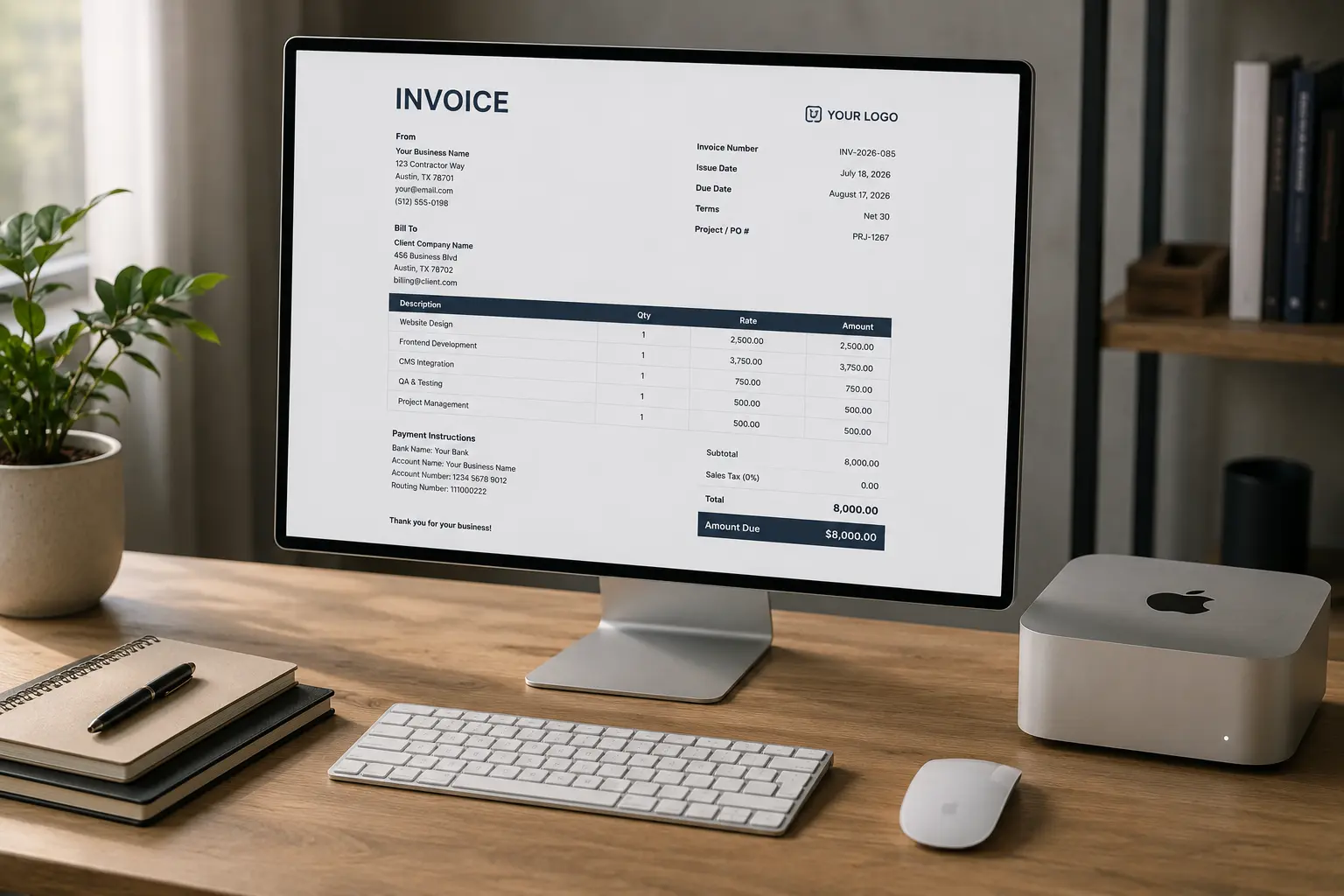
Day zero is the invoice date printed on the document. An invoice dated 3 October is due 2 November. If you sent it on the 3rd but dated it the 1st, the clock started on the 1st. Some terms move the trigger: "net 30 ROG" starts the count when the client receives the goods, and "net 30 EOM" starts it at the end of the invoice month, so an EOM invoice dated 3 October is due 30 November. Say which one you mean. Our contractor invoice template guide shows where the date and the terms sit on the document; the point here is that the date is the term.
Calendar days, not business days
Net 30 counts weekends and holidays. No statute and no common practice makes it 30 business days. What the guides skip is what happens when day 30 is a Saturday. Legally, unless the contract says otherwise, the invoice is still due on the Saturday; in practice, AP systems pay on the next business day and nobody argues. If the difference matters to you, write the rule in: "If the due date falls on a weekend or a US federal holiday, payment is due the preceding business day." Preceding, not following. That's a choice you only get to make if you make it in writing.
Net 15, net 30, net 60, net 90 and due upon receipt, compared
Every net term is the same instrument with a different number on it, so the comparison is really about who carries the float and for how long. Here's how net 30 payment terms and their siblings line up, from the seller's chair.
Common payment terms and what each one means for the seller
| Term | When the money is due | Who typically uses it | What it means for the seller |
|---|---|---|---|
Due upon receipt | The day the client receives the invoice | Small jobs, first-time clients, retail, rush work | No credit extended. The fastest cash, and the hardest to enforce, because receipt is hard to prove |
Net 15 | 15 calendar days after the invoice date | Freelancers, agencies, service work | Half the float of net 30; still reads as professional |
Net 30 | 30 calendar days after the invoice date | The default across US business-to-business work | One month of credit per invoice; the term most AP systems expect |
Net 45 | 45 calendar days after the invoice date | Mid-size buyers negotiating down from net 60 | Rarely the seller's idea; a compromise term |
Net 60 | 60 calendar days after the invoice date | Large corporate and retail buyers | Two months of float; you're funding their working capital |
Net 90 | 90 calendar days after the invoice date | Big-box retail, some manufacturing supply chains | A quarter of credit; only viable with financing or a price premium |
2/10 net 30 | 2% off within 10 days, full amount at 30 | Distributors, wholesalers, anyone with margin to trade for speed | Buys speed at a known price (the math is in the next section) |
What the table can't show
Two things. First, the number a client asks for tells you how they see the deal: a client who opens with net 60 sees you as a supplier, not a partner, and that's useful to know before you price the work. Second, terms drift. Net 30 in the contract becomes net 45 in cash once the invoice sits in an approval queue, which is why the 2025 Atradius Payment Practices Barometer found 43% of credit-based business-to-business sales in the United States overdue.
Net 30 EOM and the other variants
"Net 30 EOM" means 30 days after the end of the invoice month, so anything dated in October is due 30 November regardless of the day it was issued. "Net 30 ROG" starts at receipt of goods. "Net 30 MFI" (month following invoice) means the 30th of the next month. Wholesalers use these because they batch invoices. If you're a services business you almost never want them: they add days for the client and ambiguity for you.
2/10 net 30: what the early-payment discount really costs
"2/10 net 30" means the client can take 2% off if they pay within 10 days; otherwise the full amount is due at 30. It looks like a small courtesy. It isn't. You're paying 2% of the invoice to receive the money 20 days sooner, and once you annualize that, it's one of the most expensive forms of financing a small business can offer.
The formula is short: discount ÷ (1 minus discount) × 365 ÷ days saved. For 2/10 net 30 that's 0.02 ÷ 0.98 × 365 ÷ 20 = 37.2% a year. Put differently, a client who skips the discount and pays on day 30 is borrowing from you at 37% annual interest, and a client who takes it is charging you 37% for a 20-day loan. The number is the same from both chairs, which is exactly why most CFOs with a working treasury take the discount, and why a 2% "courtesy" on a $50,000 invoice is $1,000 handed over for less than three weeks of speed.
When 37% is still the right price
It can be. If your alternative is a merchant cash advance, invoice factoring, or a credit line you don't have, paying 2% for certainty beats all of them. What isn't fine is offering the discount by habit, to every client, on every invoice. Offer it where cash timing matters to you and where the client actually pays early. Drop it everywhere else, and never print it on an invoice whose contract doesn't mention it, because a discount the client didn't sign for is a price cut you can't take back.
What an early-payment discount costs the seller, as an annual rate
Each discount term converted into an annual interest rate with the formula discount ÷ (1 minus discount) × 365 ÷ days saved. Read it as what you pay for early cash, or as what the client pays for waiting.
1% off for paying 20 days early: 0.01 ÷ 0.99 × 365 ÷ 20.
The most common discount term. 2% for 20 days of speed.
Same 2%, but the client saves you 35 days instead of 20.
Same 2% spread over 50 days saved; the cheapest of the common terms.
3% for 20 days: 0.03 ÷ 0.97 × 365 ÷ 20.
The shorter the gap between the discount window and the due date, the more expensive the discount. 2/10 net 60 costs the seller less than half of 2/10 net 30 for the same 2%.
Run the numbers before you print them
1/10 net 30 costs 18.4% a year, 2/10 net 30 costs 37.2%, 3/10 net 30 costs 56.4%. If you wouldn't take a loan at that rate, don't offer a discount at that rate. A smaller discount with a longer window, such as 2/10 net 60 at 14.9%, is usually the better trade when a client wants both.

Two dates matter on a 2/10 net 30 invoice: day 10, where the discount ends, and day 30, where the credit does.
What net 30 costs you as the seller
The obvious cost is time. You've done the work and the money arrives a month later, so every net 30 client adds a month of your costs to the cash you need on hand. A studio billing $30,000 a month on net 30 terms is permanently financing $30,000 of its clients' operations. That's the cash flow arithmetic even when everyone pays on the day.
Nobody pays on the day. The 2025 Atradius survey put 43% of credit-based business-to-business sales in the United States past due, and 5% of long-overdue invoices ending as bad debt. Net 30 on paper is closer to net 45 in cash, and an invoice that slips past 60 days has a real chance of never arriving. Once a client is that late you're no longer managing receivables, you're deciding whether it's a breach of contract worth pursuing.
Then the quieter costs. Chasing: every overdue invoice is an email, a call and a "checking in on this" you'd rather not send. Concentration: one large net 60 client can take more cash out of a small business than five net 15 clients put in. And the discount trap from the previous section, where the tool you use to speed payment up is priced like a loan you'd never sign.
Net 30 vs net 45: is longer ever better for you?
No. For the seller, a longer term is only ever a concession, and the question is what you get for it. Net 45 is usually a buyer's counter to net 30, and the mistake is to treat the days as the negotiation. Negotiate price instead: net 45 at a higher rate, or net 30 with a 2/10 discount for the client who'd rather pay early. Days are the client's variable. Money is yours. The same holds for net 30 vs net 60: the buyer gains a month, and you fund it.
Where net 30 goes wrong
The term you agreed and the date the money lands are different numbers. Track days sales outstanding by client, not as an average: a portfolio at 38 days can hide one client at 75. That client's terms are the ones you renegotiate, not everyone's.
Is net 30 the law? What US, EU and UK rules actually say
Are net 30 payment terms the law? In the United States, no. There's no federal statute that tells one business how fast to pay another. Net 30 is a convention, and a contract can say net 10 or net 120 and be enforceable either way. The exceptions are specific:
- Federal agencies. Under the Prompt Payment Act, an agency that hasn't agreed a date must pay 30 days after receiving a proper invoice and owes interest automatically when it's late.
- Freelancers in New York. The Freelance Isn't Free Act, statewide since 2024, requires payment on the contract date or within 30 days of completion when the contract is silent, and a written contract once one client is worth $800 over 120 days.
- Freelancers in Illinois. The Freelance Worker Protection Act does the same for contracts of $500 or more within 120 days, for contracts taking effect after 1 July 2024.
- Everyone else: the contract. Which is the whole argument for having one.
The European Union and the United Kingdom
Cross the Atlantic and the default flips. The EU's Late Payment Directive (2011/7/EU) makes 30 days the fallback when nothing is agreed and caps business-to-business terms at 60 calendar days unless both sides expressly agree otherwise and the longer term isn't grossly unfair; public authorities get 30. Late payment triggers interest at the reference rate plus at least 8 percentage points and a flat EUR 40 per invoice, with no reminder required. The UK kept the same shape: 30 days by default, 60 by agreement, statutory interest at 8% over the Bank of England base rate, and fixed recovery compensation of GBP 40, 70 or 100 depending on the size of the debt.
What a 90-day term from abroad really means
That it's negotiable by law. A large European or British client can ask for net 90; you can point at the directive and the 60-day ceiling, and the request usually shrinks. What US law gives you is thinner: the right to charge whatever the contract says, and nothing where the contract says nothing. Which brings us back to writing it down.
Statutory payment deadlines when the contract names no date
Days a payer has when the contract is silent, under the statutes named in this section. Private US business-to-business payments are not on the chart because no statute sets a deadline for them.
5 CFR 1315.4: 30 days after receipt of a proper invoice, interest automatic after that.
GBL § 1411: 30 days after completion when the contract names no date; contracts of $800 and up.
Contracts of $500 and up taking effect after 1 July 2024.
Directive 2011/7/EU: 30 days when no date is fixed; interest at the reference rate plus 8 points.
Late Payment of Commercial Debts Act: 30 days after the invoice or delivery, whichever is later.
Longer only by express agreement that isn't grossly unfair to the creditor.
Net 30 turns out to be the statutory floor almost everywhere it's written down. The 60-day figure is the negotiated ceiling in the EU and UK, not the norm.
Late payment interest you never wrote down is interest you can't charge
In the US, late fees and interest are contractual: no clause, no fee, whatever the invoice footer says later. Check your state's usury limit before you set the rate, keep it modest, and put it in the signed agreement, not just on the invoice. In the EU and UK the interest is statutory, but the clause still saves you the argument.
How to write net 30 payment terms on an invoice and in the contract
Payment terms live in two places, and the order matters: the contract first, the invoice second. The invoice repeats what the contract already says, so a client who disputes a due date is disputing something they signed, not something you typed later. If your contract is silent on payment, the invoice is a proposal, and in a dispute a proposal is worth roughly what it cost to print.
Wording that holds up
Use all five parts, in this order:
- The term and the trigger. "Payment terms: net 30 from the invoice date." Not just "net 30". The trigger is the part people argue about.
- The date. "Due: 2 November 2026." A calendar date on the invoice ends the counting argument before it starts.
- The consequence. "Balances unpaid after the due date accrue interest at 1.5% per month." State the rate and the start. "Late fees may apply" is not a term.
- The discount, if you offer one. "2% discount if paid within 10 days of the invoice date." Only where the math above says it's worth it.
- The rails. Bank details, card or ACH options, and who to email with a question. A client who has to ask for your bank details pays a week later.
The contract needs the same clause plus two things the invoice can't carry: what counts as delivery or acceptance (the trigger for milestone work), and what happens on day 31, whether that's interest, suspension of work, or both. The agreement is where the terms are born; the invoice only repeats them. And keep proof of the two dates that start the clock: send the invoice through a channel that records delivery, and let the signed contract carry a timestamp for acceptance. Our guide to automating billing after e-signature walks through the setup.
Better still, tie the two together. When the invoice is generated from the signed contract, the terms can't drift: contract-linked payments issue the invoice with the same net term, the same rate and the same due date the client already signed, and there's nothing left for accounts payable to "clarify". That's the difference between chasing a date and pointing at one.
Make the due date part of the signature
Chaindoc issues the invoice from the signed contract, so the net 30 term, the due date and the late-fee clause the client agreed to are the ones they're billed on, with a timestamped record of when they agreed.
See contract-linked paymentsNet 30 accounts: the buyer's side of the same term
Search "net 30" and many of the results are about net 30 accounts: supplier accounts that let a business buy now and pay in 30 days, marketed to new companies as a way to build business credit. Office-supply, packaging and print vendors run them, and the pitch is that on-time payments get reported to the business credit bureaus, which helps the company qualify for larger credit later.
It's the same instrument, trade credit, seen from the other chair. For the vendor, a net 30 account is a marketing tool: a customer with an open account reorders from the vendor that already trusts them. For the buyer, it's short-term credit that costs nothing if paid on time and quietly costs a lot if it isn't, because a reported late payment sits on the business credit file the way it would on a personal one.
Two things to check before opening one. Whether the vendor actually reports to a bureau, and to which, because an account that reports nowhere builds nothing. And whether there's an annual fee or a minimum order, since "free credit" behind a $99 membership is a $99 loan. If you're the vendor offering net 30 accounts, the checks are the mirror image: a credit application, a limit, and a signed credit agreement that names the term, the interest and what happens at day 31.

A net 30 account is underwriting dressed as a courtesy: the vendor decides how much credit to extend, the buyer decides whether it's worth reporting.
The seller's version of a net 30 account
Offering net 30 to a new customer isn't generosity, it's underwriting. Set a limit you can afford to lose, put the terms in a signed credit agreement, and review the limit after three on-time invoices, not before.
When to refuse net 30, and what to offer instead
Net 30 is a fine default with a client who has paid you before. It's a poor default with everyone else, and the way to refuse it without a fight is to offer something specific.
- New client, any size: 50% deposit on signature, balance net 15 on delivery. The deposit is the credit check. A proforma invoice requests it without creating a tax document before the work exists.
- Small invoices, under a thousand dollars or so: due upon receipt, by card or ACH. Thirty days of float on $400 costs the client nothing and costs you an accounting entry.
- Fixed-bid projects: milestones, each due net 15 from acceptance, with acceptance defined in the contract.
- Large clients that require net 60 or net 90: accept, and price it. A term is a loan, and a loan has a rate. Add it to the quote rather than swallowing it, or offer 2/10 net 60 if you'd rather have the cash than the margin.
- Anyone who wants "net 30 from approval of the invoice": no. Approval isn't a date you control, and a term that starts on the client's decision isn't a term.
The pattern behind all five: shorten the time between the work and the money for the people you don't know yet, and sell the time to the people who can pay for it. Net 30 is what's left for the middle, the clients who have earned a month. That isn't a rule against net 30 payment terms. It's the reason they were invented.
Sources
The documents this article rests on, in the order the text leans on them. Statutes link to the official text, not to a summary.
- 1.B2B payment practices trends in North America 2025 · Atradius Payment Practices BarometerSource of the 43% overdue and 5% bad-debt figures for the United States.
- 2.5 CFR § 1315.4 — Prompt payment standards · Cornell Legal Information InstituteParagraph (g): 30 days after receipt of a proper invoice when the contract names no date.
- 3.New York General Business Law § 1411 — Contracted compensation payments · New York State SenatePayment on the contract date or within 30 days of completion; § 1410 defines the $800 threshold.
- 4.Freelance Worker Protection Act · Illinois Department of Labor$500 within 120 days; payment within 30 days of completion when the contract is silent; contracts taking effect after 1 July 2024.
- 5.Directive 2011/7/EU on combating late payment in commercial transactions · EUR-LexArticle 3: 30-day default and 60-day ceiling; Article 6: EUR 40 fixed sum; Article 2(6): reference rate plus at least 8 points.
- 6.Late commercial payments: charging interest and debt recovery · GOV.UK30 days by default, 60 by agreement, 8% over base rate, GBP 40 to 100 recovery costs.
- 7.Prompt Payment · U.S. Department of the Treasury, Bureau of the Fiscal ServiceThe Act's purpose and the current interest rate for late federal payments.
Frequently Asked Questions
Answers to popular questions about Chaindoc and secure document workflows.
Net 30 means the full invoice amount is due 30 calendar days after the invoice date. "Net" says no discount applies, and the date printed on the invoice, not the delivery date, starts the count unless the terms name a different trigger such as receipt of goods or end of month.
Yes. Net 30 counts calendar days, so weekends and holidays are in. If day 30 lands on a Saturday the invoice is still due that day unless your terms say otherwise; most accounts payable teams pay on the next business day. Want the earlier day instead? Write "due the preceding business day" into the contract.
Take the invoice date and add 30 days. An invoice dated 3 October is due 2 November; one dated 15 January is due 14 February. For net 30 EOM, add 30 days to the last day of the invoice month, so any October invoice is due 30 November. Print the resulting invoice due date on the invoice so nobody has to count, and name the trigger in the contract so nobody can argue about where the count starts.
A 2% discount if the client pays within 10 days of the invoice date, with the full amount due at 30. Annualized, that discount costs the seller 37.2% a year (0.02 ÷ 0.98 × 365 ÷ 20), which is why buyers with cash on hand almost always take it. Offer it only where early cash is worth that price to you.
As the seller, net 30, and net 15 where you can get it: every extra 30 days is a month of your costs you finance for the client. As the buyer, net 60 is better for exactly the same reason. When a large client insists on net 60, treat it as a loan and price it into the quote, or offer 2/10 net 60 so the client can choose speed over margin instead of taking both.
More e-signature and blockchain guides
Practical guides on electronic signatures, blockchain audit trails, and secure document management — handpicked to build on what you just read.