Signature Validity Is Unknown: What Acrobat Means and How to Fix It
Adobe says signature validity is unknown? That is a trust problem, not a damaged file. Here is what the message means and how to fix it in four checks.

Sign a document and check the record yourself.
Start nowSignature validity is unknown: what Acrobat is actually telling you
A signed contract lands in your inbox. You open it, and instead of a reassuring green tick there's a yellow bar across the top: "At least one signature has problems." Or you click into the signature and read "Signature validity is unknown."
Here's the thing that nobody puts in the banner. Those messages are usually about trust, not tampering.
A PDF signature check answers two separate questions. Did this file change after it was signed? And can your reader trace the signing certificate back to a root it recognises? The second question fails far more often than the first, and it fails for reasons that have nothing to do with the document. Adobe Acrobat Reader ships with its own list of trusted certificate authorities, and that list isn't the same as the EU Trusted List, or the one Windows keeps, or the one your bank's PKI team maintains.
So when a signature comes back not verified, you're normally looking at one of these:
- The signing certificate chains up to a root your reader doesn't carry. Nothing is wrong with the signature. Your copy of Acrobat simply hasn't been told to trust that issuer.
- The file changed after signing. A re-save, a flattened form field, or a pass through a mail gateway that "optimised" the attachment. This one is real, and it's the case worth catching.
- The certificate had expired by the time you opened it, and there's no trusted timestamp to prove it was still valid at the moment of signing.
- Revocation data can't be reached, so the check finishes as indeterminate rather than as a pass or a fail.
Four different situations, one identical warning. That's the actual problem with verifying a signature in a PDF, and it's why "just look at the tick" is bad advice.
What each PDF signature message means
| What your reader shows | What it usually means | What to do |
|---|---|---|
Signature is valid (green tick) | Integrity holds and the chain reached a trusted root | Read the certificate subject anyway, see below |
Signature validity is unknown | The chain didn't reach a root your reader trusts | Check the issuer, then validate against a trust list that covers it |
At least one signature has problems | A catch-all warning, most often the same trust gap | Open the Signatures panel for the per-signature detail |
The document has been altered or corrupted since it was signed | Integrity failed, the signed bytes changed | Ask the sender to resend the original file, unmodified |
Signature is invalid | The maths failed outright, or a revoked certificate was used | Treat the file as untrusted until the sender explains it |
How to verify a signature in a PDF
Three minutes of work, and the order matters more than the tooling.
First, check there's a signature to verify at all
A picture of somebody's handwriting isn't a digital signature. Neither is a typed name in a script font, nor a JPEG pasted into a form field. Those carry no certificate, so there's nothing to verify, and no validator on earth will produce a verdict on them.
Open the Signatures panel in Adobe Acrobat Reader. On Windows and macOS it's the fountain pen icon down the left side of the window, or View, then Show/Hide, then Navigation Panes, then Signatures. Empty panel? Then the document was never digitally signed, and what you're looking at is decoration. Our guide to signing a PDF covers the difference between the two.
Then read the per-signature detail, not the banner
Right-click the signature in that panel and choose Show Signature Properties. Adobe's own documentation on validating digital signatures walks through the dialog. This is where Acrobat stops being vague: you get the signer's name, the issuing certificate authority, the signing time, and whether the document changed after the signature was applied.
Worth doing while you're in there: click Show Signer's Certificate and read the Subject field. More on why that matters further down.
Then get a verdict that names the failing check
Acrobat's summary is a single yes-or-no about whether Acrobat is happy. It won't tell you which of the four underlying checks went wrong, and that's the answer you need to do anything useful.
Run the same file through a validator that reports the checks separately. Chaindoc's PDF signature validation returns integrity, certificate chain, revocation status, timestamps and the PAdES profile as five distinct results, each with its own pass or fail. When something fails you can see whether the document was altered or your reader simply doesn't trust the issuer, which are wildly different problems with wildly different responses.
Don't re-save the PDF while you're investigating. Opening a signed file and saving it again, even without editing anything visible, can rewrite the byte stream and break the signature for real. The same goes for flattening form fields, printing to PDF, or letting a document management system re-encode the attachment. If you need to share the file, forward the original as an attachment rather than a copy that's been through your tooling.
How to validate a digital signature in a PDF without Acrobat
Plenty of people don't have Acrobat, and the free Reader is a 500 MB install for a job that takes one upload. A browser-based checker gets you there faster, and it sidesteps the trust-store problem entirely, because a server-side validator can be pointed at a trust list far broader than whatever your desktop happens to carry.
What separates a useful online checker from a useless one is the report. Ask for four things:
- Integrity as its own line. The hash was recomputed over the signed bytes and either matched or didn't.
- The certificate chain, with the issuer named. "Untrusted" without naming the root is not an answer.
- Revocation checked at the signing time, via OCSP or CRL, rather than against today's date.
- Timestamp status, because that's what pins the signing moment down when a certificate later expires.
Chaindoc runs those checks through the EU DSS library, the European Commission's own open-source validation code, with the EU Trusted List as the primary trust anchor and the large commercial certificate authorities on top of it. It handles all four PAdES baseline profiles, takes files up to 50 MB, and doesn't keep the document after the check. You confirm your email address with a one-time code first, which is worth knowing before you start.
Not a PDF? PAdES is only the PDF flavour of the same idea. Signed XML carries XAdES, a .p7m or .p7s wrapper carries CAdES, and .asice containers are ASiC.
See Which Check Actually Failed
Upload a signed PDF and Chaindoc validates it against the EU Trusted List through the EU DSS library: cryptographic integrity, the certificate chain, revocation status, embedded timestamps and the PAdES baseline profile, each reported separately. Nothing installs on your machine, files up to 50 MB are accepted, and the PDF isn't stored after the check. You confirm your email with a one-time code before the first report.
Validate a PDF SignatureHow to verify a signature in a PDF on your phone
Honest answer first: phones are bad at this, and it isn't your fault.
Mobile PDF readers were built to display documents, not to run certificate path validation. The stock viewers on both mobile systems are the weakest link here.
On iPhone and iPad
Opening a signed PDF in Files, Mail or Books shows you the signature's appearance and nothing about its validity. There's no signature panel and no certificate detail, because iOS doesn't ship a PDF trust store for this purpose. A signed document can look perfect in Apple's preview while its cryptography is broken.
On Android
Adobe Acrobat Reader for Android does better. Tap the signature and you'll get a panel with the signer's name and a validity summary. What you won't reliably get is the certificate chain, the revocation status, or a timestamp verdict, and those are exactly the parts that decide the outcome.
What actually works on a phone
Use the browser. A server-side validator does the certificate work on its own infrastructure and sends back a full report, so the phone only has to render a page. Chaindoc's PDF check works this way and accepts a file straight from your phone's storage or from a cloud drive.
My own take: if a signature matters enough to check, check it on a machine where you can read the certificate subject properly. Verifying a signature in a PDF on mobile is fine for a quick yes-or-no on a document you already expected. It's thin evidence for a payment you're about to make.
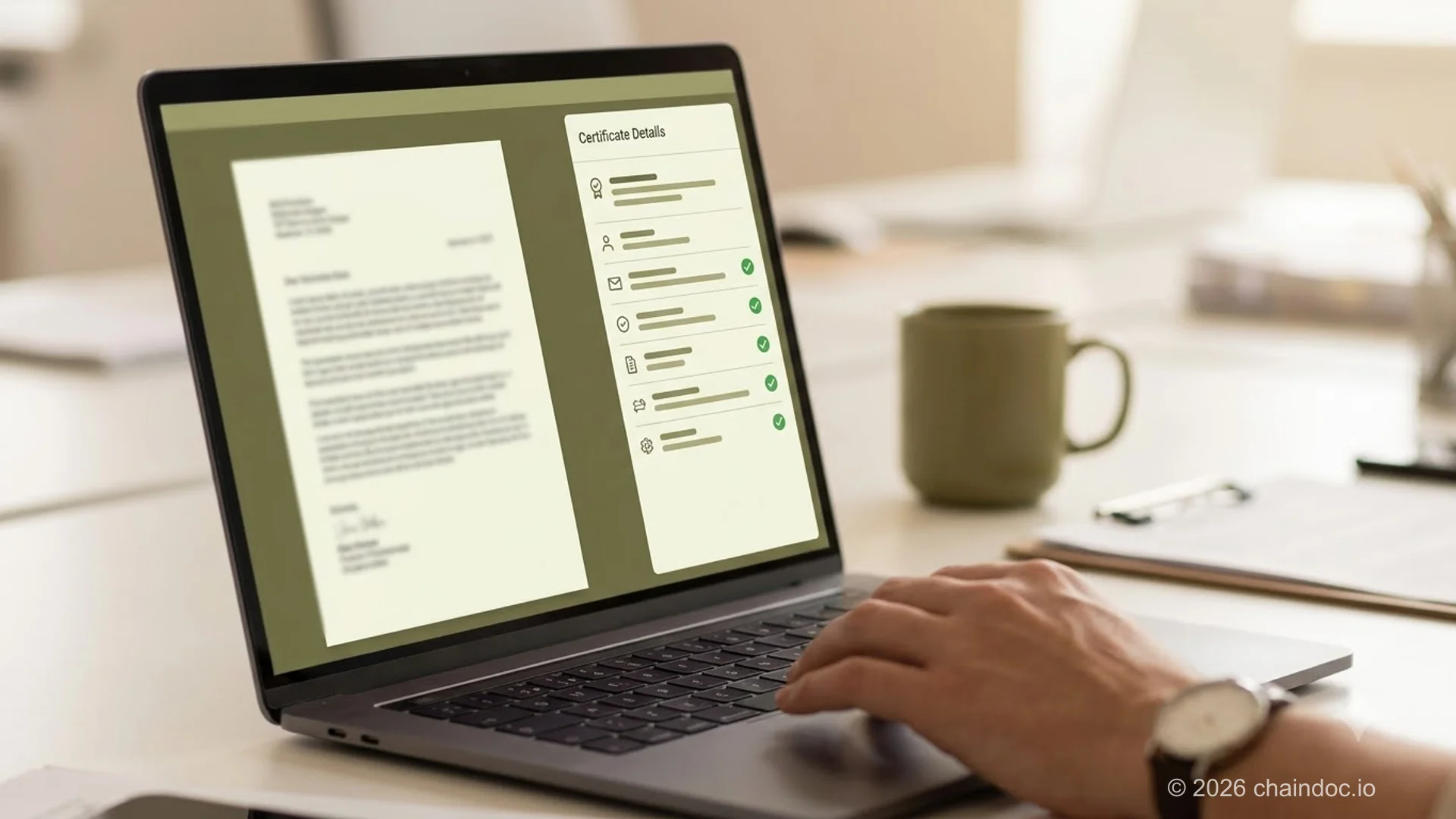
The banner gives you one verdict. The per-signature detail, and a validator that separates the four checks, give you something you can act on.
The four checks behind a valid verdict
PDF digital signature verification comes down to the same four tests, whichever tool runs them. Knowing what each one proves tells you how much a failure should worry you.
Integrity. The validator recomputes the hash over the bytes that were signed and compares it with the hash sealed inside the signature. One changed byte fails this. When integrity fails, the document genuinely isn't the document that was signed, and no amount of trust configuration will fix that.
Certificate chain. The signing certificate points at its issuer, which points at its issuer, up to a root. The validator has to reach a root it trusts. Fail here and you've learned something about your trust configuration, not about the file.
Revocation. Certificates get revoked when a private key leaks or an employee leaves. The check queries OCSP or a CRL, and the question is whether the certificate was revoked at the moment of signing. A certificate revoked last week doesn't invalidate a contract signed two years ago. Validators that compare against today's status get this backwards.
Timestamp. A trusted timestamp from a time-stamping authority fixes when the signature was created. Without one, you're relying on the clock of whoever signed, which is worth roughly nothing in a dispute. Timestamps are also what keep a signature checkable after the certificate expires, which is the whole point of the PAdES-BASELINE-T profile and above, defined in ETSI EN 319 142.
One pattern to remember: integrity failing is a document problem. The other three failing are usually configuration or infrastructure problems. Sort out which kind you have before you email the sender.
Why the certificate chain fails more often than the cryptography
This is the part that surprises people, so it's worth being blunt about it. There is no single global list of trusted signing authorities. There are several, they disagree, and your verdict depends on which one your software consulted.
Adobe maintains the Approved Trust List, a set of certificate authorities that Acrobat and Reader trust out of the box. The EU maintains the EU Trusted List, which is the legal basis for qualified signatures under eIDAS. Microsoft keeps its own root program for Windows. A bank or a government agency running an internal PKI trusts its own root and nobody else's.
The same signed PDF can therefore be valid in one place and unknown in another, with no contradiction. Both answers are correct about the question they were asked.
Two practical consequences.
If a supplier's signature shows as unknown in Acrobat, look at who issued the certificate before you accuse anyone of anything. A national certificate authority outside the AATL, an internal corporate CA, or a qualified EU provider that Adobe hasn't picked up will all produce that message on a perfectly sound signature.
And if you need the eIDAS answer specifically, ask a validator that treats the EU Trusted List as its anchor. Qualified status isn't a property of the mathematics; it's a lookup against a list. Qualified trust service providers and the EU Trusted List explains how that lookup works and why a valid signature and a qualified one are different verdicts.
Why Indian DSC-signed PDFs show signature not verified
The largest single group of people meeting this message are in India, and they are almost always looking at a government PDF. An income-tax acknowledgement, a GST registration certificate, an MCA filing, a DGFT licence, a university or board mark sheet. All of them carry a Digital Signature Certificate issued by a Certifying Authority licensed by the Controller of Certifying Authorities — eMudhra, (n)Code Solutions, Sify and Capricorn are among the ones you'll see named in the signature properties.
None of those signatures is broken. Acrobat ships with Adobe's own trust list, and whether your copy carries the CCA chain depends on the reader you have and how its trust settings were last updated. That is why the same mark sheet reads valid on the office machine and unknown on your laptop. It is the trust question from the section above, and India is simply where it happens most.
What actually fixes it
Get the issuing authority's certificate and the CCA root, import them into Acrobat's trusted identities, and mark them as trusted for signatures and certified documents. Then close the file and reopen it. Menu labels move around between reader versions, so don't chase a particular click path: the thing that has to become true is that the issuer sits in your reader's trust store. Once it does, the verdict changes without anyone touching the document.
What makes it worse
Re-saving the file, printing it to PDF, or running it through a tool that rewrites the document. Any of those breaks the one check that was passing — the document-integrity check — and turns a trust problem into a real one you cannot undo. If a portal will let you download the original again, do that instead.
One honest limitation on our side. Chaindoc's validator anchors on the EU Trusted List, so a CCA-issued file comes back from it with intact cryptography and an unresolved chain. That still answers the question that matters most in a dispute — whether the file changed after signing — but for a verdict on the Indian trust chain itself you want a validator built around that chain.
You can add a root to Acrobat's trusted identities yourself: Edit, then Preferences, then Signatures, then Identities & Trusted Certificates. Import the issuing authority's certificate, tick "Use this certificate as a trusted root", and revalidate. Do it for issuers you have an actual reason to trust, one at a time. Adding roots wholesale to make warnings disappear removes the only mechanism that would have told you about a certificate you shouldn't have accepted.
What a valid signature doesn't tell you
A green tick is narrower than it looks. It says this file came from the holder of this certificate and hasn't changed since. Everything below is outside its scope.
Who signed it
A signature can be cryptographically flawless and belong to the wrong company. Open the certificate subject and read the organisation name and any tax or registration identifier in it, then compare that against the counterparty you think you're dealing with. Payment-diversion fraud works by looking plausible, and a valid signature from an entity that isn't quite your supplier looks very plausible indeed. This is the check almost nobody runs, and it's the one that catches real fraud.
Whether the signature is qualified
Valid and qualified are separate answers. Qualified means the issuing service appears on a national trusted list with qualified status, which carries the legal weight of a handwritten signature across the EU. Most valid signatures aren't qualified, and for most documents that's fine. Our qualified electronic signature guide covers when the distinction actually bites.
Whether the document is binding
Signature validity is a technical verdict about a file. Enforceability depends on consent, capacity, the applicable law and whatever the contract itself says. A valid signature is strong evidence, not a legal conclusion.
Whether the contents are correct
Somebody can sign a wrong number perfectly. If the invoice amount looks off, the cryptography has no opinion on that. Validating an invoice signature works through where this bites in accounts payable.
Where people get PDF signature checks wrong
Five patterns, all avoidable.
Trusting the banner and stopping there. The summary bar tells you Acrobat's mood, not which check failed. Open the panel.
Sending a screenshot as proof. An image of a green tick proves nothing to an auditor, a court or a counterparty. What proves something is the original signed file plus a validation report generated while the revocation responders were still answering. Store both.
Re-saving the file during the investigation. Covered above, and it happens constantly. The signature was fine until somebody opened it in a tool that helpfully rewrote it.
Checking validity today instead of at signing time. Certificates expire. That's their normal end state, not a defect. A 2023 contract signed with a certificate that expired in 2024 is perfectly sound, provided a timestamp proves when the signing happened.
Adding trusted roots until the warning goes away. Tempting, and it converts a useful alarm into silence.
The summary worth keeping: when you get signature not verified in PDF, find out which of the four checks failed before you do anything else. Integrity is a document problem and needs the sender. The other three are usually trust plumbing, and they're yours to fix. Chaindoc's verification hub works out the format for you and reports each check on its own line, for PAdES, XAdES, CAdES and ASiC alike.
One Form for Every Signature Format
PAdES in a PDF, XAdES in a signed XML, CAdES in a .p7m wrapper, or an ASiC container. Chaindoc detects which one you're holding, checks integrity, the certificate chain, revocation and timestamps, and looks the signer up against the EU Trusted List. Detached signatures accept the original document alongside them. Nothing you upload is stored after the check.
Verify Any SignatureFrequently Asked Questions
Answers to popular questions about Chaindoc and secure document workflows.
Start by finding out what failed, because "not verified" covers four different problems. Open the Signatures panel in Acrobat Reader, right-click the signature and choose Show Signature Properties. If the message is about trust, meaning the chain didn't reach a root your reader recognises, the fix is on your side: import the issuing authority's certificate into Preferences, Signatures, Identities & Trusted Certificates, and mark it as a trusted root. If the message says the document changed since signing, nothing on your side will fix it, and you need the original file from the sender. A validator that reports the checks separately tells you which case you're in within a few seconds.
Open the Signatures panel in Adobe Acrobat Reader, right-click the signature, and choose Show Signature Properties for the signer, issuer and signing time. For a verdict that names the specific check that failed, upload the file to an online validator instead.
Upload the signed PDF to a browser-based validator and read the report. A good one reports integrity, the certificate chain, revocation status and timestamps as separate results rather than a single yes or no. Chaindoc runs these through the EU DSS library with the EU Trusted List as its trust anchor, accepts files up to 50 MB, and doesn't keep the document afterwards. You confirm your email address with a one-time code before the first check.
Four conditions have to hold at once: the recomputed hash matches the signed bytes, the certificate chain reaches a root the validator trusts, the certificate wasn't revoked at the time of signing, and ideally a trusted timestamp fixes when signing happened. Any validator worth using reports those four on separate lines. If it gives you one word and no breakdown, you can't tell a tampered document from an unfamiliar certificate authority, and those need opposite responses.
Certifying is a different operation from signing, and Acrobat treats it that way. A certifying signature is applied once, by the document author, and it declares what recipients are still allowed to change: nothing at all, form filling only, or form filling plus comments. Approval signatures come afterwards from the people who sign. Only one certifying signature can exist per document, and it must be the first one.
More e-signature and blockchain guides
Practical guides on electronic signatures, blockchain audit trails, and secure document management — handpicked to build on what you just read.


