What Is a Statement of Work (SOW)? A Complete Guide
Learn what a Statement of Work is, what sections it must include, how the 3 SOW types differ, and how to create a legally binding SOW with eSignatures.

Introduction
A statement of work (SOW) is a binding project document that defines exactly what a service provider will deliver, on what timeline, for how much, and what counts as accepted work. It records the scope, milestones, payment schedule, acceptance criteria, and change-control rules in one place. Once both parties sign, the SOW (not the emails, not the call notes) is the contract that governs the engagement and decides every dispute about scope, payment, or quality.
This guide covers what every SOW section must contain, how the three main SOW types differ, a ready-to-use template, and how to execute and store the document so it holds up legally from day one.
Key takeaways
- A SOW is the binding contract that defines what gets delivered, when, for how much, and what counts as done.
- Three SOW types (fixed-price, time & materials, milestone-based); picking the wrong one causes more disputes than bad drafting.
- Six sections every SOW needs: introduction, scope, deliverables, timeline, payment terms, and governance.
- Most SOW failures trace back to vague scope, no acceptance criteria, or no change-control clause.
- Sign with compliant eSignatures and a tamper-proof audit trail to satisfy the ESIGN Act, UETA, and eIDAS.
What is a statement of work (SOW)?
A statement of work is a formal project document that defines the complete scope of work between a service provider and a client. It records the deliverables, the milestone timeline, the payment schedule, the acceptance criteria, and the rules for handling changes. Once both parties sign, the SOW becomes the binding contract, not the emails, not the Slack threads, not the verbal promises.
The SOW is not a proposal or a project charter. It is the full contractual package. A Statement of Work can run two pages for a small freelance job or twenty-plus pages for a government contract. The U.S. Federal Acquisition Regulation (FAR) prescribes required SOW components for federal procurement, which signals how seriously regulators treat it as a binding instrument.
For freelancers, agencies, and the businesses that hire them, the SOW creates a precise shared understanding before any work begins. Our software development agreement template includes a pre-built SOW appendix for dev projects.
The data backs this up. The Standish Group CHAOS Report has consistently found that roughly one-third of all projects fail outright, while over half experience significant cost overruns or delays. One of the top causes is incomplete requirements and poor scope definition, exactly what a well-drafted SOW prevents.
Why a statement of work matters
A good SOW protects you from:
- Scope creep. Explicit out-of-scope definitions stop clients from adding requirements without adjusting cost or timeline.
- Subjective approvals. Documented acceptance criteria turn deliverable approval into a pass/fail check.
- Unpaid work. Milestone-linked payment schedules tie every invoice to a defined, accepted output.
- Disputes without evidence. A signed SOW with a tamper-proof audit trail is the first thing a lawyer asks for.
- Ownership confusion. Named responsibilities eliminate the "I thought you were handling that" conversation.
Pro tip: the most expensive SOW mistake isn't a missing clause, it's vague acceptance criteria. Spell out exactly what "done" looks like, in measurable terms, before either party signs.
Is a SOW legally binding? jurisdiction overview
Yes, a properly drafted and signed SOW is legally binding in all major jurisdictions. The legal weight does not rest on the document title. It rests on three things: clear offer and acceptance, a meeting of minds on material terms, and authenticated signatures. Electronic signatures are explicitly recognized in the United States, European Union, United Kingdom, and Australia, which means a digitally signed SOW carries the same evidentiary weight as a handwritten one.
Non-repudiation and the audit trail. When you sign a SOW using a service that generates a cryptographic document hash and a time-stamped certificate of completion, neither party can later credibly deny signing. Each signature is bound to the document's unique hash, so altering even a single character after signing invalidates the hash and makes tampering immediately detectable.
How major jurisdictions treat SOW eSignatures
| Jurisdiction | Governing law | Electronic signature recognition |
|---|---|---|
United States (Federal) | ESIGN Act (2000) | Same legal effect as handwritten signatures for commercial agreements |
United States (State) | UETA (49 states) | Uniform framework confirming electronic records and signatures are enforceable |
European Union | eIDAS (EU 910/2014) | Three-tier system: SES, AES, QES; QES carries the highest evidentiary weight |
United Kingdom | UK Electronic Communications Act 2000 | Electronic signatures legally recognized; ESIGN-equivalent post-Brexit |
Australia | Electronic Transactions Act 1999 | Electronic signatures valid for commercial contracts including SOWs |
When do you need a statement of work?
Not every engagement requires a full SOW, but most professional service relationships do. Use one whenever the project has named deliverables, fixed dates, milestone-linked payment, or external parties involved. The point is to put accountability in writing before money changes hands or work begins. Use a statement of work when:
- The project has defined deliverables and a fixed timeline. If you can name the outputs and the dates, you need a SOW to hold both sides accountable.
- Multiple stakeholders or teams are involved. Cross-functional projects (procurement, legal, delivery) need a single contractual reference point.
- Payment is tied to milestones or acceptance. Any arrangement where invoices depend on deliverable approval requires a SOW to define what "approved" means.
- You are working with an external vendor, freelancer, or agency. The SOW sits between an internal RFP and the actual execution. For freelancers and agencies, it replaces the informal handshake.
- Government or enterprise contracts require it. Federal and state procurement rules, including the FAR's performance work statement (PWS) and statement of objectives (SOO) frameworks, mandate a formal work statement before any spend is authorized.
When a SOW is *not* necessary: simple one-off purchases, internal task assignments with no contractual weight, or engagements already governed by an existing master service agreement with sufficiently detailed task orders.
What are the 3 types of statement of work?
Pick the wrong SOW structure and you will create disputes no matter how carefully you draft the rest of it. The contract model has to match the project type. Most B2B service engagements use milestone-based or fixed-price structures; government and enterprise IT projects often combine both, with a fixed-price ceiling and T&M provisions for out-of-scope change orders.
SOW types compared
| Type | Best for | Pricing model | Risk distribution |
|---|---|---|---|
Fixed-price | Well-defined projects with stable requirements | Single lump sum or % at fixed milestones | Provider bears overrun risk; client gets cost certainty |
Time & materials | Open-ended exploration or evolving scope | Hourly/daily rate × actual hours logged | Client bears overrun risk; provider has flexibility |
Milestone-based | Multi-phase projects with clear phase gates | Payment unlocked when each milestone is accepted | Balanced, payments are earned, not assumed |
The milestone-based model is worth a closer look if you have ever chased an invoice, payment doesn't trigger until the client formally accepts the deliverable, which keeps both sides honest about what "done" means.
What sections must a SOW include?
Every SOW must answer six questions: who, what, when, how, how much, and what counts as done. The sections below map to those questions. Skip any one of them and you create the gap that scope creep, payment delays, and disputes pour through. Treat the list as a minimum, not a maximum, and adjust depth based on project size and risk.
1. introduction and purpose
Keep this short but complete. An uninvolved reader should immediately understand what the project is and why it exists.
- Project background: Summarize the business problem or opportunity the project addresses.
- Parties involved: Identify the legal entity names of both client and provider.
- High-level objective: State the primary goal in one or two sentences using measurable outcome language.
2. scope of work
This is the operational core. If you only get one section right, make it this one. List every task the provider will perform and explicitly name what is excluded. A work breakdown structure (WBS) works well for multi-phase projects.
- In-scope tasks: Describe all work to be completed with sufficient precision that a third party could assess completion.
- Out-of-scope exclusions: Explicitly name services and activities that won't be provided. This single clause prevents more scope disputes than anything else in the document.
- Reference any technical standards, required tools, or service level agreement (SLA) targets that apply.
3. deliverables and acceptance criteria
This is where most SOWs fall apart. If your acceptance criteria are subjective, you will argue about whether the work is done. Write them so a reviewer who was not involved in the project can look at a deliverable and decide pass or fail.
- Deliverables list: Itemize every output the client will receive, reports, software builds, design files, documentation, training materials.
- Acceptance criteria: Define the measurable conditions each deliverable must meet (e.g., "The dashboard loads in under 2 seconds on a 4G connection").
- Review and sign-off process: Specify the review window (e.g., "Client has 5 business days to accept or reject"), the feedback format, and the escalation path.
- Deemed acceptance: State what happens if the review window expires without a formal rejection, typically the deliverable is deemed accepted.
4. timeline and milestones
Dates make things real. Without hard dates, milestones drift and nobody notices until the budget is gone.
- Project duration: State the official start date and the projected completion date.
- Key milestones: Break the project into named phases, each with a specific completion date.
- Task dependencies: Identify which tasks must be completed before others can begin, and note client-side dependencies.
- Hard due dates for each deliverable, not just phases.
5. payment terms and schedule
Money is where SOW disputes get ugly. Spell out every detail of how and when payment happens.
- Cost structure: Fixed-price, T&M, or milestone-based.
- Total contract value: State the total fee in the agreement currency.
- Payment schedule: Map specific payment amounts to specific milestones or calendar dates.
- Invoicing procedure: How and when invoices are submitted, the payment method, and the net payment terms (e.g., Net-15 or Net-30).
- Late payment clause: Specify the interest rate or penalty for payments made after the due date.
- Expense policy: Clarify which out-of-pocket expenses are reimbursable and under what conditions.
6. governance: change control and dispute resolution
Every project changes after it starts. The question is whether those changes happen through a controlled process or through arguments about who said what on a call three weeks ago.
- Change request procedure: All scope changes must be submitted in writing, with documented impact on cost and timeline, before any out-of-scope work begins. A contract addendum may formalize significant changes.
- Change order template: Reference or append a change order form that both parties sign before extra work is authorized.
- Dispute resolution mechanism: Specify whether disputes go to mediation, arbitration, or litigation, and in which jurisdiction.
- Termination clause: Define the conditions under which either party may terminate, the notice period required, and how deliverables and payment are handled upon termination.
- Force majeure and indemnification: Address unforeseeable events that may prevent performance and clarify each party's indemnification obligations for third-party claims.
What does a minimal SOW template look like?
Use this structure as the skeleton for any SOW. Replace bracketed items with project-specific content. The same eight sections work for a $5,000 freelance gig or a $5 million enterprise build, only the depth of each section changes. Treat anything beyond this as enrichment, but do not skip these blocks.
Ready to Draft Your SOW?
Use Chaindoc to create, sign, and manage your Statement of Work with milestone-linked payments and a tamper-proof audit trail.
How do you write a strong SOW step by step?
Writing a strong SOW is a five-step discipline: discover, draft, define acceptance, install change control, and execute with eSignature. Each step closes a specific failure mode you would otherwise discover in week eight of the project. Skip a step and the contract holds up only as long as both sides feel cooperative.
Step 1: conduct a discovery session
Before you write a single line, you need a complete picture of the project. Meet with the client to surface not just the stated request but the underlying business problem. If you assume the client will provide design assets by a specific date, name that date in the SOW.
- Identify all stakeholders who must approve the final agreement.
- Establish clear, measurable success criteria, what does "done" look like?
- Record every assumption explicitly. Unwritten assumptions become future disputes.
Step 2: draft with specific, unambiguous language
Ambiguity is the most expensive word in any contract. Replace every vague qualifier with a measurable specification.
- Instead of "multiple revisions," write "up to three rounds of client-initiated revisions per deliverable."
- Instead of "a modern design," write "a responsive web interface that passes Google's mobile-friendly test and loads in under 3 seconds on a standard 4G connection."
- Use active voice and name the responsible party: "The Vendor will deliver the wireframes", not "wireframes will be delivered."
Step 3: define acceptance criteria before any work begins
Acceptance criteria must be set in the SOW, not negotiated after delivery. For each deliverable, specify the measurable condition (performance threshold, format, review window) and the consequence of non-response (deemed acceptance after X business days).
Step 4: include a formal change control clause
A change control clause isn't optional. Without one, every verbal request for extra work becomes an enforceable obligation you cannot price or decline. Require all changes in writing, signed before work begins.
Step 5: execute with eSignatures and an audit trail
This is where the draft becomes a legally binding agreement. Use a secure eSignature service (see our digital signature software buyer's guide for a comparison) to apply compliant, cryptographically validated signatures. The service should generate a certificate of completion, a tamper-evident record that captures each signer's identity, IP address, timestamp, and the document hash at signing.
- Every signatory receives the final executed SOW as an unalterable record.
- Store it in a centralized system, not email. A central document repository prevents version confusion and makes retrieval for audits or disputes immediate.
What SOW mistakes derail projects?
You can follow every template online and still end up with a SOW that causes problems. The same mistakes show up again and again, not because people are careless, but because these traps are not obvious until you have been burned by them.
1. vague or incomplete scope definition
Writing "develop a website" without specifying pages, features, browser support, or performance benchmarks gives the client unlimited room to expand expectations. Use a work breakdown structure (WBS) to decompose every deliverable into named tasks with measurable outputs.
2. no out-of-scope section
An in-scope list without explicit exclusions is an open invitation for scope creep. State what you will *not* do with the same precision you use for what you will do. If content migration, SEO optimization, or third-party integrations are excluded, name them.
3. missing or subjective acceptance criteria
Phrases like "to the client's satisfaction" or "high quality" are not acceptance criteria, they are dispute triggers. Define measurable thresholds: load times, error rates, review-cycle counts, and specific testing conditions. Include a deemed-acceptance clause with a fixed review window.
4. no formal change control clause
Without a signed change order requirement, every verbal request for extra work becomes an obligation you cannot price or decline. The change control process must require written requests, documented impact on cost and timeline, and dual-party sign-off before any new work begins.
5. choosing the wrong SOW type for the project
A fixed-price SOW on an exploratory R&D project forces the provider to absorb unlimited risk. A T&M SOW on a well-defined deliverable removes the client's cost certainty. Match the contract model to the project's uncertainty profile.
According to World Commerce & Contracting research, poor contract management practices cost organizations an average of 9.2% of annual contract value through leakage, disputes, and missed opportunities. For a $48,000 website redesign, that's over $4,000 left on the table.
6. relying on verbal agreements
Any commitment that isn't in the signed SOW doesn't exist contractually. If the client agrees to provide assets by a specific date, that date goes in the SOW. If a phone call changes a deliverable's specification, a formal change order must follow.
7. no termination or exit clause
Projects end early for legitimate reasons, budget cuts, strategic pivots, force majeure events. Without a termination clause that addresses notice periods, payment for completed work, and deliverable handover, a premature ending becomes a legal dispute instead of an orderly wind-down.
According to PMI's Pulse of the Profession research, organizations with mature project management practices waste 28x less money than those with immature processes. A clear SOW is the single highest-impact step in that maturity gap, it converts intent into accountable, measurable work.
What does a real SOW example look like?
Templates are easier to understand when you see one filled out. Here's a condensed SOW for a website redesign, the kind of project where scope creep is practically guaranteed without clear terms. Notice how every payment is tied to something the client can actually review and accept or reject.
Project overview
Client: Acme Corp (acme-corp.com) | Provider: Studio Delta, LLC
Project: Corporate website redesign, responsive frontend, CMS migration, and SEO audit
Duration: 12 weeks (March 4, 2026 – May 27, 2026)
Contract Value: $48,000 (milestone-based)
Scope summary
In scope: UX audit of existing site, wireframes for 12 page templates, responsive frontend development (React/Next.js), CMS migration from WordPress to headless CMS, on-page SEO audit and implementation, cross-browser QA (Chrome, Safari, Firefox, Edge), and two rounds of client revision per deliverable.
Out of scope: Content writing, photography, paid advertising setup, third-party API integrations beyond the CMS, and ongoing maintenance after launch.
Milestones and payment schedule
Acceptance criteria (M3 example)
- All 12 page templates render correctly on viewports 320px–2560px.
- Lighthouse performance score ≥ 90 on mobile and desktop.
- CMS allows non-technical editors to create, edit, and publish pages without developer support.
- Client has 5 business days to review; no response = deemed accepted.
No milestone, no invoice. That's the whole point of a milestone-based structure.
How does a SOW change by industry?
The six-section structure works everywhere, but each industry has its own gotchas. The skeleton stays the same; what changes is the level of detail in scope, acceptance, and risk allocation. Below is what experienced practitioners adjust for the four most common service contexts.
IT and software development
Software SOWs must define the technology stack, hosting environment, source code ownership, and testing requirements. Acceptance criteria should reference automated test coverage thresholds (e.g., 80% unit test coverage), staging environment approval, and production deployment procedures. Include a warranty period (typically 30–90 days) for post-launch bug fixes.
Consulting engagements
Consulting SOWs are often time-and-materials, which makes clear hourly rate caps, maximum weekly hours, and expense policies critical. Define what constitutes a "deliverable" (a slide deck, a written report, a workshop) and the format in which the client receives it. Intellectual property transfer clauses matter most when the consultant produces frameworks or methodologies.
Construction and engineering
Construction SOWs reference blueprints, permits, inspection schedules, and regulatory compliance (OSHA, local building codes). Payment milestones typically align with physical completion percentages verified by an independent inspector. Material specifications, change order pricing formulas, and weather-delay provisions are standard.
Marketing and creative agencies
Creative SOWs must define revision limits explicitly, unbounded revisions are the most common source of scope creep in agency work. Specify asset formats (PSD, Figma, video resolution), usage rights and licensing terms, and approval workflows. For ongoing retainer work, an SLA defining monthly deliverables and response times is essential.
SOW vs. MSA vs. scope of work: key differences
These three documents get mixed up constantly. Each has a distinct role in the contract lifecycle, and confusing them creates accountability gaps, particularly around payment triggers, IP ownership, and which document controls when terms conflict. The table below maps when each is created, what it does, and whether it carries contractual weight on its own.
One MSA can govern an unlimited number of SOWs over the life of a client relationship. Understanding the contract vs agreement distinction helps you decide whether you need a full contract or a simpler agreement. The MSA is the permanent umbrella; each SOW is the project-specific attachment beneath it.
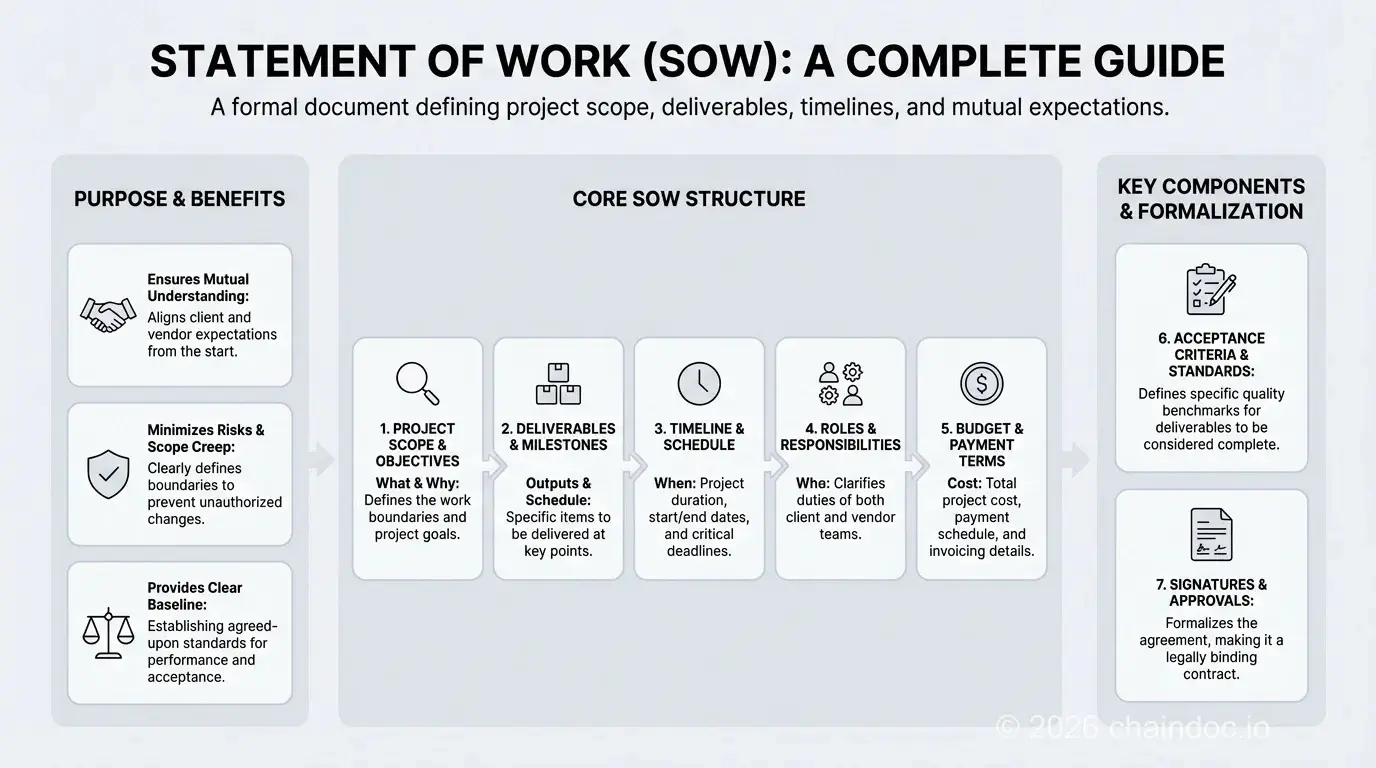
Statement of Work (SOW), key components, three SOW types, and the eSignature execution workflow.
How does Chaindoc keep SOWs defensible?
Writing a good SOW is half the battle. The other half is not losing control of it after you send it out. Email threads, file attachments, and "final_v3_FINAL.docx" filenames are where things go wrong, version control breaks down, nobody knows who approved what, and there's no record of who saw which version when. A purpose-built contract lifecycle management service turns the SOW from a static file into an active, auditable workflow.
Defensible agreements: eSignatures and tamper-proof audit trails
Legally binding agreements require more than a scanned signature image. A secure service applies cryptographically validated eSignatures and generates a complete, time-stamped audit trail that records every document view, comment, and signature event. Each signed SOW is bound to its document hash, any post-signature alteration is immediately detectable. This non-repudiation record makes your agreements defensible under the ESIGN Act, UETA, and eIDAS. Sign your SOWs with Chaindoc.
Version control and team collaboration
If your latest SOW version lives in someone's Downloads folder, that isn't version control. A central system maintains a single live document with granular access control. Internal teams see what they need; clients see what they should. Role-based access confirms that only authorized signatories can approve, and every access event is logged.
Integrated payments tied to milestone approval
The SOW's payment schedule is only valuable if it is enforced. An integrated system links contract payments directly to the milestone acceptance workflow: when a deliverable is accepted and signed off, the corresponding invoice is generated and sent automatically. The deliverable gets accepted, the invoice goes out. Everything is logged.
Sign Your SOW in Minutes
Skip the back-and-forth. Send your Statement of Work for eSignature, collect approvals, and trigger milestone payments from one dashboard.
Summary
If there is one document worth getting right before a project starts, it is the Statement of Work. It puts the informal understanding between client and provider into writing, what gets delivered, when, for how much, and what counts as accepted. Sign it with compliant eSignatures and keep a tamper-proof audit trail, and you have a legal record that holds up from kickoff to final payment.
Chaindoc handles the full SOW workflow: audit trails, milestone-linked payments, and compliant eSignature technology in one service.
Tags
Frequently Asked Questions
Answers to popular questions about Chaindoc and secure document workflows.