Contract Addendum: Meaning, Template & Examples (2026)
Contract addendum meaning, examples & free template. Learn addendum vs amendment differences and draft a legally binding one in minutes (ESIGN/UETA/eIDAS).

Sign a document and check the record yourself.
Start nowIntroduction
Addendum meaning, in plain terms: an addendum is a supplementary document attached to an existing signed contract that adds new terms, clauses, or information without altering what the parties already agreed to. It's a legally recognized add-on, not a rewrite. Once every party signs it, the addendum becomes a binding part of the original agreement, enforceable the same way the underlying contract is.
A contract addendum is one of the most misunderstood instruments in business contract management, and one of the most consequential if you get it wrong. Every long-term agreement eventually runs into new information, changed circumstances, or terms that simply weren't available at signing. Handled correctly, a contract addendum keeps your original agreement intact while adding legally enforceable new terms. Handled incorrectly, it creates ambiguity, enforceability gaps, and disputes nobody planned for.
This guide covers what a contract addendum is, how it differs from a contract amendment, when it's legally binding under U.S. (ESIGN Act, UETA) and international (eIDAS) law, and how to draft one that holds up. For general contract drafting, see our how to write a contract guide. You'll also find a 5-step drafting framework, real-world examples across real estate, lease, and employment contracts, and a look at how a digital workflow removes the version-control chaos of paper-based addendum management. Understanding the contract vs agreement distinction also helps you pick the right instrument from the start.
Poor contract management is expensive. World Commerce & Contracting research consistently finds that organizations lose an average of 9.2% of annual revenue due to ineffective contract processes. For a company generating $10 million in revenue, that's roughly $920,000 in preventable losses every year. Much of that leakage comes from mismanaged amendments and addenda that create ambiguity rather than clarity. (Source: https://www.worldcc.com/)
Actually, the legal cost of a single ambiguous addendum can dwarf the cost of a proper contract management system for an entire year.
What is a contract addendum? the core definition
A contract addendum is a separate, legally binding document attached to an original signed contract that introduces new terms, clauses, or information without altering the existing agreement. Once all parties sign it, the addendum becomes part of the original contract, one coherent set of obligations.
The word addendum comes from the Latin "addere", meaning "to add." That etymology captures the core rule: an addendum adds, it doesn't change. In practice, this distinction is where most teams get tripped up. If you need to modify, delete, or replace existing contract language, the correct instrument is an amendment, not an addendum. As the Cornell Law School Legal Information Institute defines it, an addendum is a supplemental document that's incorporated into and becomes part of the original agreement.
What makes a contract addendum valid
For a contract addendum to be enforceable, it must satisfy four structural requirements:
- Clear reference to the original contract: The addendum must identify the original agreement by its full title, execution date, and the names of all parties. This creates a verifiable, auditable link between the two documents.
- Mutual consent and signatures. Every party who signed the original contract must also sign the addendum. An addendum signed by only one party isn't binding on the others.
- Additive, non-conflicting content: The addendum may only introduce new terms. It can't contradict or overwrite existing provisions. That's what amendments are for.
- A clear effective date. The addendum must specify when the new terms take effect, which anchors the audit trail and sets the chronological sequence of obligations.
Honestly, the effective date is where most addenda fail in disputes. If two parties disagree about when a new term started, the entire addendum becomes negotiable.
Addendum vs. amendment: what's the critical difference?
One of the most common sources of contract confusion is using "addendum" and "amendment" interchangeably. They serve fundamentally different purposes, and using the wrong one can affect enforceability in ways that only surface during a dispute.
The rule is simple: a contract addendum adds new information; a contract amendment changes existing information.
Think of the original contract as a house. A contract addendum is like adding a new room: new space that didn't exist before, built alongside the existing structure. A contract amendment is like renovating the kitchen, where the existing space is being altered. You wouldn't call a renovation an addition, and courts apply the same logic.
That said, the distinction isn't always obvious in real life. If you add a new payment schedule that replaces the old one, is that an addendum or an amendment? Most lawyers would call it an amendment because it alters existing obligations, not just adds new ones. When in doubt, get a second opinion before labeling the document. For software projects, our software development agreement template includes a standard change-order clause that dovetails with addenda.
When to use a contract addendum (for additions)
Use a contract addendum when:
- You need to introduce terms that were unavailable or undecided at the time of original signing.
- You want to attach supplementary exhibits, schedules, pricing lists, or technical specifications.
- You need to add a disclosure required by new regulations without disturbing existing clauses.
- A new party (such as a subcontractor) needs to be incorporated with its own scope of obligations.
When to use a contract amendment (for changes)
Use a contract amendment when:
- You need to correct an existing term such as a wrong date, an incorrect payment amount, or a clerical error.
- You need to replace an entire clause with updated language.
- You need to delete an obligation that both parties agree is no longer applicable.
- You need to extend a deadline that was specified in the original agreement.
Addendum vs. amendment and related terms: quick reference
| Term | Purpose | Example |
|---|---|---|
| Contract Addendum | Adds new terms or information to an existing contract without changing existing provisions. | Adding a pet policy clause to a finalized lease agreement. |
| Contract Amendment | Modifies, replaces, or deletes existing terms in a signed contract. | Changing the monthly rent from $1,500 to $1,600 in an existing lease. |
| Appendix | Provides supplementary reference material that supports but isn't part of the operative terms. | A glossary of technical terms attached to an IT services agreement. |
| Exhibit | A documentary attachment expressly referenced and incorporated in the contract body. | A floor plan attached to and referenced in a commercial lease. |
| Endorsement | Adds or modifies conditions, most commonly in insurance policies. | Adding flood coverage to a homeowner's insurance policy mid-term. |
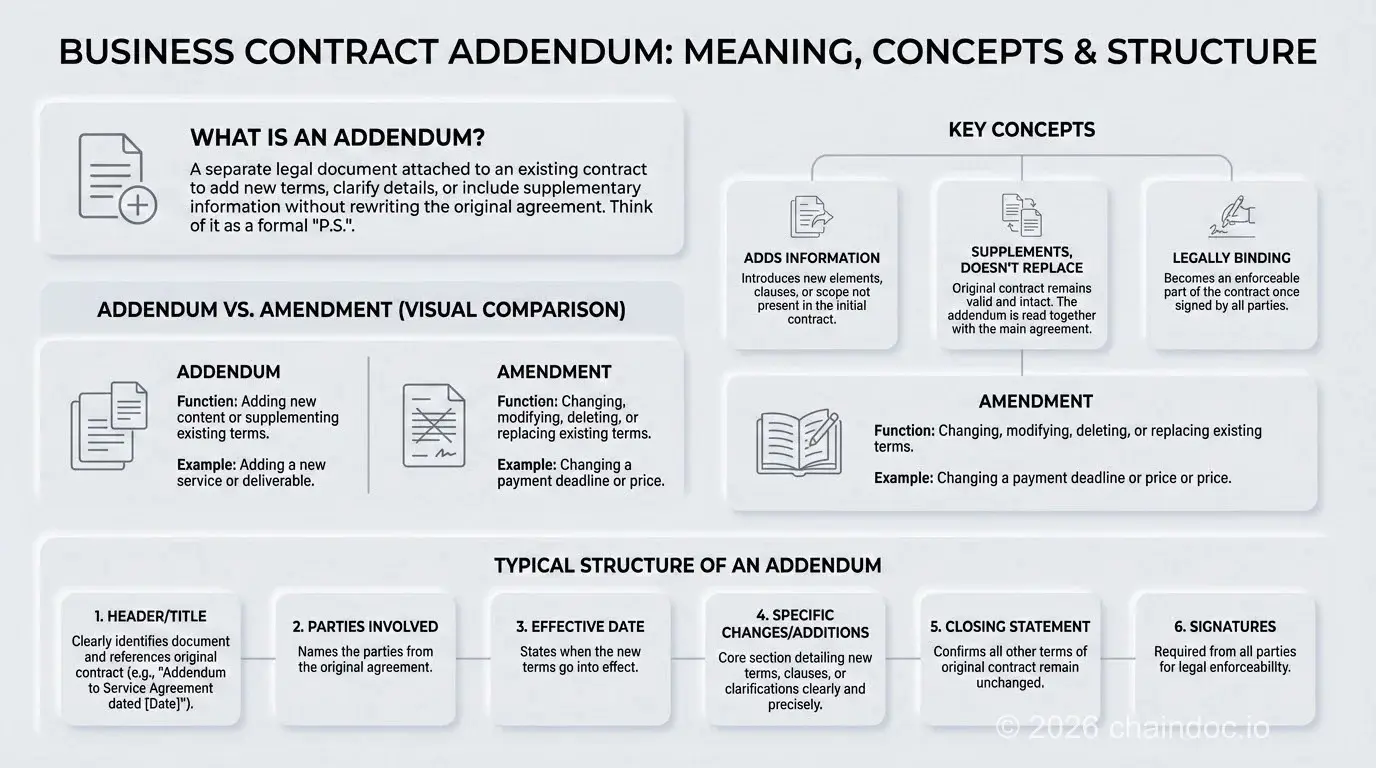
Contract addendum vs. amendment: a visual guide to choosing the right contract modification instrument.
Is a contract addendum legally binding? jurisdiction overview
Yes. A properly executed contract addendum is legally binding in all major jurisdictions, provided it meets the execution requirements of the original agreement and is signed by all parties.
The legal framework governing addenda executed with electronic signatures varies by jurisdiction. The table below covers the primary frameworks relevant to business contracts:
| Jurisdiction | Governing Law | E-Signature Standard | Addendum Recognition |
|---|---|---|---|
| United States (Federal) | ESIGN Act (Electronic Signatures in Global and National Commerce Act) | Electronic signatures legally equivalent to wet signatures for most contracts | Fully recognized; addenda executed with compliant e-signatures are enforceable |
| United States (State) | UETA (Uniform Electronic Transactions Act, adopted in 49 states) | State-level complement to ESIGN Act; same enforceability standard | Fully recognized across all UETA-adopting states |
| European Union | eIDAS Regulation | Three tiers: SES (Simple), AES (Advanced), QES (Qualified). QES has full legal equivalence to handwritten signature. | Recognized at all three tiers; high-value contracts may require AES or QES |
| United Kingdom | Electronic Communications Act 2000 + Law Commission guidance | Electronic signatures valid for most contracts; deeds require additional formalities | Recognized for standard commercial addenda |
| Australia | Electronic Transactions Act 1999 (federal) + state equivalents | Electronic signatures valid where parties consent to electronic execution | Recognized; addenda follow the same rules as the underlying contract |
What makes a contract addendum legally enforceable?
Across all jurisdictions, three elements determine enforceability:
- 1.Mutual consent: All parties who signed the original contract must sign the addendum. Unilateral additions aren't enforceable.
- 2.Consideration: For the addendum to be binding as a standalone modification, there must be mutual benefit or a recital of consideration, not just a reference back to the original contract. State contract law governs this requirement directly. California Civil Code Section 1698, for example, spells out exactly how a written contract can be modified: by a further writing, by an executed oral agreement, or by an oral agreement backed by new consideration. Most states follow a similar framework, so check the specific statute where your contract is governed before assuming an addendum needs no consideration at all.
- 3.Non-contradiction: The addendum must not conflict with the original contract's material terms. Where conflict exists, courts typically require an amendment, not an addendum, to resolve it.
A tamper-evident, time-stamped audit trail is the primary evidence of mutual consent if an addendum is ever challenged in court. The ESIGN Act (15 U.S.C. 7001 et seq.) and UETA as adopted by the Uniform Law Commission both explicitly recognize electronic signatures on contract addenda as legally equivalent to wet ink signatures. Worth noting: a cryptographically sealed audit trail from a compliant e-signature tool is significantly harder to dispute than a paper signature and a fax confirmation.
Practical examples of contract addenda
Here's how a contract addendum works across the most common business contract types.
Real estate purchase agreement addendum
Real estate transactions generate more addenda per deal than almost any other contract category. Specific details (financing terms, inspection conditions, property disclosures) often aren't finalized when the purchase agreement gets signed. Common examples:
- Financing Contingency Addendum: Specifies that the purchase is conditional on the buyer securing a mortgage at or below a defined interest rate by a defined deadline. This protects the buyer without altering the purchase price or closing date in the original agreement.
- Inspection Addendum: Makes the sale conditional on a satisfactory property inspection, outlining repair thresholds and the buyer's right to withdraw or renegotiate if conditions aren't met.
- Property Disclosure Addendum. Required by statute in many jurisdictions, it formally discloses known defects, environmental hazards, or HOA obligations not covered in the standard purchase agreement.
- Appraisal Gap Addendum: Increasingly common in competitive markets, this addendum specifies how much of a gap between the appraised value and the purchase price the buyer agrees to cover in cash if the property appraises low. Skip it, and a single low appraisal can unwind an otherwise solid deal.
Lease agreement addendum
Landlords and tenants add addenda constantly. Property-specific rules, new tenancy arrangements, and regulatory disclosures rarely fit neatly into a standard lease. Common examples:
- Pet Addendum: Defines permitted pet types, size restrictions, non-refundable pet fees, and the tenant's liability for pet-related damage, without altering base rent or lease duration.
- New Occupant Addendum. Officially adds a new roommate or co-tenant to an existing lease, assigning joint responsibility for rent and lease compliance without requiring a whole new lease to be executed.
- Shared Amenities Addendum: Establishes rules for pool, gym, or parking access, including hours, guest policies, and usage fees, when those details weren't in the original lease.
Employment contract addendum
Employment agreements get supplemented after signing more often than people expect. Roles evolve, compensation structures change, hybrid work created entirely new categories of obligations. Common examples:
- Non-Disclosure Agreement (NDA) Addendum. Defines the scope of confidential information and the employee's post-employment obligations to protect trade secrets.
- Performance Bonus Structure Addendum: Specifies the exact metrics, measurement periods, and payout formulas for variable compensation. Honestly, this one prevents more disputes than any other addendum type.
- Remote Work Policy Addendum: Defines approved work locations, equipment responsibilities, data security requirements, and expense reimbursement terms for remote employees.
- Title and Role Change Addendum: Records a new title, reporting line, and adjusted duties after a promotion, without resetting notice periods, equity vesting, or non-compete terms the way a brand-new contract might. The savings clause keeps everything else from the original offer letter intact.

How to draft an enforceable contract addendum: a 5-step framework for business teams.
How to write an enforceable contract addendum: a 5-step guide
A contract addendum is only as strong as its drafting. An ambiguous or incomplete addendum creates exactly the legal uncertainty it was meant to resolve. This five-step framework applies to any contract type.
Step 1: draft a clear, descriptive title
The title must immediately identify the document as an addendum, specify what it adds, and link it to the original contract. A complete title includes:
- The document type: begin with "Addendum to..."
- The original contract name (e.g., "Master Services Agreement")
- The original contract's execution date
- A sequential number if multiple addenda will exist (e.g., "Addendum No. 2 to Master Services Agreement dated January 15, 2026")
This format creates an unambiguous chronological record that survives CLM review, due diligence, and legal discovery.
Step 2: reference the original agreement and all parties
The opening paragraph must formally link the addendum to the original contract. Identify all original parties by their full legal names, recite the original contract's title and execution date, and state that this addendum is incorporated into and made part of that agreement. This recital establishes legal continuity. Without it, an addendum can be treated as a standalone document, which creates exactly the kind of enforceability gap you're trying to prevent.
Step 3: draft the new terms with precision
This is where most addenda go wrong. Apply these drafting principles:
- Use specific, unambiguous language. Avoid phrases like "reasonable time" without defining what "reasonable" means in this context.
- Organize new provisions with numbered or lettered paragraphs matching the style of the original contract.
- Cite the exact location in the original contract where each new term attaches. For example: "The following Section 7.3 is hereby added to the Agreement: [new term]."
- Don't include cross-references that depend on external documents unless those documents are also incorporated as exhibits.
Step 4: include a savings clause
A savings clause explicitly states that the addendum doesn't replace or supersede the original contract except as specifically stated. The standard formulation:
"Except as expressly set forth in this Addendum, all terms and conditions of the [Contract Name] dated [Date] shall remain in full force and effect. In the event of a conflict between this Addendum and the original Agreement, the terms of this Addendum shall control solely with respect to the subject matter addressed herein."
Skip this clause and you risk one party later arguing the addendum superseded provisions you both intended to keep.
Step 5: execute with all required signatures
An addendum isn't enforceable until signed by all parties to the original agreement. The signature block must:
- Match the format of the original contract's signature block
- Include fields for printed name, title, and signing date for each party
- Be completed by individuals with actual authority to bind their organizations
After execution, store a fully executed copy in a centralized contract repository linked to the parent agreement. For high-stakes contracts, a compliant e-signature tool with a tamper-evident audit trail removes the chain-of-custody risks inherent in paper execution. Fair warning: if you're managing addenda across multiple contracts by email thread, you'll eventually lose track of which version was actually signed.
Blockchain E-Signatures vs Traditional E-Sign Tools
| Capability | Chaindoc (Blockchain) | DocuSign / Adobe Sign |
|---|---|---|
Immutable audit trail | Cryptographic hash on public ledger | Vendor-controlled database log |
Tamper detection | Instant — any byte change breaks the hash | Manual audit, often delayed |
Legal frameworks | ESIGN, UETA, eIDAS, HIPAA, GDPR | ESIGN, UETA, eIDAS |
Identity verification | Optional KYC, result in the audit trail | Email/SMS OTP only |
Cross-border recognition | Independently verifiable worldwide | Depends on vendor's local presence |
Pricing model | Tiers from €9/mo, no per-signature fee | Per-envelope / per-user fees |
Vendor lock-in | Records remain valid even if vendor disappears | Records depend on vendor's continued service |
Court admissibility | Strongest evidentiary tier (cryptographic + timestamped) | Standard electronic-record tier |
Securely managing contract addenda with a digital workflow
Legal validity is only half the equation for a contract addendum. The other half is operational integrity: the right version is in circulation, all required signers execute the document, and a complete audit trail exists to prove every step of the process.
Paper-based addendum management consistently fails on all three counts. Physical documents are lost, fax copies lack clear provenance, and handwritten wet signatures provide no cryptographic proof of identity or document integrity. For regulated industries like finance, healthcare, and real estate, this isn't just inconvenient. It's a compliance risk.
Risks of manual contract addendum management
Organizations that manage addenda manually face four recurring failure modes:
- Version control breakdown: Multiple drafts circulate simultaneously, making it impossible to confirm which version was actually signed without manually reconstructing an email thread.
- Missing signatures. Without automated routing, addenda frequently reach some but not all required signers, creating an enforceable gap even when parties acted in good faith.
- No verifiable audit trail: Manual processes can't prove when an addendum was proposed, reviewed, or executed. That's exactly the information required for dispute resolution and regulatory audit.
- Fragmented document storage. Addenda filed separately from their parent contracts create due diligence risk during M&A transactions, contract renewals, and litigation discovery.
Benefits of an e-signature service for contract addenda
A compliant e-signature service addresses all four failure modes:
- Centralized contract repository: Every contract addendum lives alongside its parent agreement in a single, permission-controlled system. No fragmentation, and full contract lifecycle visibility.
- Automated signing workflows. Routing rules enforce the correct signing sequence, send reminders, and block circulation of any version other than the current one.
Actually, the speed difference is dramatic. Aberdeen Group research shows that e-signature users report sending an average of 22.6 proposals or quotes per sales rep per month, compared with just 10.4 among non-adopters. For contract addenda, that same efficiency gain means faster execution and fewer expired deadlines. (Source: https://www.aberdeen.com/cmo-essentials/signed-sealed-delivered-integrating-e-signature-into-the-b2b-sales-cycle/)
- Legally binding, time-stamped e-signatures: Under the ESIGN Act (US), UETA (US states), and eIDAS (EU), electronic signatures executed on a compliant service carry the same legal weight as wet signatures. Each signature is cryptographically bound to the document at the moment of signing, so tampering is detectable.
- Immutable audit trail. Every action (document open, field completion, signature applied) is recorded in a tamper-evident log that serves as admissible evidence of mutual consent and proper execution.
How Chaindoc creates a verifiable system of record for contract addenda
Chaindoc is built for the full contract lifecycle, not just the signing moment. When a contract addendum is executed through Chaindoc, it's automatically linked to its parent contract in a single, unified record. Every action, from the first view to final signature, is captured in a cryptographically sealed audit trail that can't be altered after the fact.
This produces a system of record that satisfies ESIGN Act, UETA, and eIDAS requirements for electronic execution, provides tamper-evident proof of document integrity, and keeps the signed addendum stored as part of the complete agreement history, not as an isolated file.
Manage contract addenda in one verifiable system with Chaindoc.
That said, no digital workflow can compensate for a poorly drafted addendum. The technology enforces process. It doesn't replace legal judgment. If the terms are ambiguous, the audit trail will only prove that everyone signed something ambiguous.
Managing contract addenda with confidence
A contract addendum is a legally powerful instrument when drafted and executed correctly. The distinction between an addendum and an amendment (adding versus changing) is the starting point. Which legal framework applies (ESIGN Act, UETA, or eIDAS) determines enforceability by jurisdiction. And the five-step drafting process (title, recital, new terms, savings clause, execution) keeps the document strong under review.
One variable remains: how the addendum is routed, signed, stored, and linked to its parent contract. A digital workflow with a tamper-evident audit trail is no longer optional for organizations that manage contracts at scale. Securely manage your contract addenda in one system to eliminate manual risk and build a defensible record of every agreement.
Industry Outlook and Further Reading
According to the eIDAS Regulation 910/2014, the U.S. ESIGN Act (Public Law 106-229), and NIST IR 8202 on Blockchain Technology, blockchain-anchored electronic signatures meet the highest tier of evidentiary requirements across major jurisdictions. Industry analysts report that organizations adopting blockchain document workflows reduce contract-cycle time by 60% and recover roughly $3,000 per team per month in administrative cost — about 4x the ROI of partial digitization.
Compare available tiers on the Chaindoc pricing page and browse more practical guides in the Chaindoc blog to find the workflow that fits your team.
Frequently Asked Questions
Answers to popular questions about Chaindoc and secure document workflows.
An addendum is a document added to a signed contract that changes or adds to its terms while leaving the original agreement in force. The plural is addenda. It differs from an annex or exhibit, which is attached to a contract to supply detail without altering what was agreed, and from an amendment, which in most drafting conventions edits the original text directly rather than sitting alongside it. An addendum is only effective once every party to the original contract signs it, and it should state explicitly that all other terms remain unchanged.
A contract addendum adds new terms or information to an existing agreement without changing existing provisions. A contract amendment changes, replaces, or deletes terms that already exist in the signed contract. The practical test: if you're introducing something new, use an addendum. If you're modifying something already written, use an amendment. For example, attaching a new pricing schedule that didn't exist at signing is an addendum; changing the price in a clause that's already there is an amendment. Using the wrong instrument can create ambiguity about which terms are operative and may affect enforceability if a dispute lands in court.
Yes. A properly drafted contract addendum is legally binding once all required parties sign it, provided it clearly references the original contract and meets the execution formalities of that agreement. Under the U.S. ESIGN Act and UETA, and under the EU eIDAS Regulation, addenda executed with compliant electronic signatures carry the same legal weight as those signed with wet ink. A tamper-evident audit trail serves as evidence of mutual consent if the addendum is challenged.
Yes, in the vast majority of business contracts. An addendum binds only the parties who sign it. If the addendum affects rights, obligations, scope, timing, or payment, all affected parties from the original agreement must sign for the update to be enforceable. An addendum signed by fewer than all original parties creates an enforceability gap and may be challenged as unauthorized. For multi-party agreements, verify signer authority before circulation and keep a complete audit trail of who received, reviewed, and executed the document.
Usually not. Most commercial contract addenda are valid with standard signatures (electronic or wet) if the underlying contract doesn't require notarization. However, certain contract types (real estate deeds, mortgages, some government contracts) and certain jurisdictions impose additional formalities. The reliable rule is to mirror the execution requirements of the original agreement: if the original required notarization or witnesses, apply the same standard to the addendum. When in doubt, ask the notary or attorney who handled the original signing rather than guessing, since getting this wrong can delay closing or recording.
More e-signature and blockchain guides
Practical guides on electronic signatures, blockchain audit trails, and secure document management — handpicked to build on what you just read.