Software Development Agreement: Complete Guide + Free Template
Download a free software development agreement template. Covers IP rights, payment terms, acceptance testing, and more. Customize and sign online in minutes.

Sign a document and check the record yourself.
Start nowIntroduction
Most software projects don't fail because the developers were bad at coding. They fail because nobody wrote down what "done" means. The Standish Group's CHAOS Report puts the success rate for software projects at just 31%. and scope disagreements, unclear IP ownership, and disputed payment terms are the most common culprits.
Actually, a software development agreement fixes all of that before work begins. It's the contract between a client and a developer (or agency) that defines what gets built, who owns it, what it costs, and what happens when something goes sideways. Without one, you're relying on good faith and memory, and courts don't accept either. In practice, most disputes aren't about bad intent. They're about different memories of the same conversation.
This guide covers everything: when you need a software development agreement, the four contract types and when to use each, every clause that actually matters, and a free downloadable template you can customize for your project. If you already know the basics and want to get straight to the template, skip ahead to the template section. Otherwise, the context matters, especially the IP section, which is where most agreements quietly fail. Here's the thing: fixing a vulnerability discovered in production is roughly 30 times more expensive than catching it during development, according to NIST research. That stat alone should justify every line in your acceptance testing clause. For a broader look at how agreements differ from contracts, our guide to contracts vs. agreements covers the legal distinctions worth knowing. When you're ready to draft, our how to write a contract guide provides a step-by-step framework.
What is a software development agreement?
A software development agreement (SDA) is a legally binding contract between a client and a software developer or development company. It defines the scope of work, payment structure, delivery timeline, intellectual property ownership, confidentiality terms, and what happens if either party needs to exit the arrangement.
The SDA isn't a proposal, a project brief, or a Slack thread confirming the work. Honestly, I've seen all three attempted as 'contracts,' and none ended well. It's the formal legal record of what both sides agreed to before development started. Once signed, it's the document you'll reference if there's a dispute, and the document a court will read if it comes to that.
What an SDA covers
A properly drafted software development agreement will address:
- Scope of work: what the developer will build, with enough specificity that a third party could assess completion
- Deliverables and milestones: what gets delivered, in what form, and by when
- Payment terms: total fee, payment schedule, and what triggers each payment
- IP ownership: who owns the code after it's written
- Confidentiality: what proprietary information each party must keep private
- Acceptance testing: how the client evaluates whether the delivered software meets requirements
- Warranties: what the developer guarantees about the software's functionality
- Termination conditions: how either party can end the agreement and what happens to work already completed
Some clients confuse the SDA with a Statement of Work. There's overlap, but they're not the same thing. That said, the distinction matters more than most people think.
When do you need a software development agreement?
Short answer: any time you're paying someone to build software, or getting paid to build it.
The contract matters whether you're hiring a solo freelancer for a two-week project or engaging a 20-person agency for a 12-month product build. The scale changes; the need for written terms doesn't.
You should have a software development agreement when:
- You're outsourcing software development: especially to offshore or remote teams where jurisdiction differences complicate informal agreements
- Custom software is being built: the more bespoke the work, the more IP ownership needs explicit documentation
- Multiple development phases exist: milestone-based payments require written acceptance criteria to trigger each phase
- Sensitive data or systems are involved: any project touching customer data needs confidentiality and security clauses
- You're building on proprietary frameworks: pre-existing code that gets incorporated into custom deliverables creates messy ownership questions without a clear agreement
- You're working across borders: governing law and jurisdiction must be named when the developer and client are in different countries
The short answer on when you can skip a full SDA: almost never. Even very short, low-value work governed by a comprehensive master service agreement should have a written SOW attached. But even then, most attorneys would tell you to do the paperwork. Here's the thing: the cost of writing a one-page SOW is trivial compared to the cost of a scope dispute on a 'simple' project.
Verbal agreements aren't contracts
In most jurisdictions, a verbal agreement for software development is technically enforceable, but almost impossible to prove. If a client disputes what was agreed, the burden of proof falls on whoever claims the agreement existed. A written SDA signed by both parties removes that ambiguity entirely. Honestly, it's the cheapest insurance you'll ever buy.
Types of software development agreements
There's no single SDA template that fits every engagement, and anyone who tells you otherwise is selling something. The contract structure needs to match how the project is priced and scoped, and choosing the wrong structure creates incentives that work against good outcomes.
| Contract Type | Best For | Payment Model | Who Bears Risk |
|---|---|---|---|
| Fixed-Price | Well-defined projects with stable requirements | Lump sum or % at defined milestones | Developer bears overrun risk; client has cost certainty |
| Time & Materials (T&M) | Exploratory work or projects where requirements will evolve | Hourly/daily rate x actual hours logged | Client bears overrun risk; developer has flexibility |
| Dedicated Team | Ongoing product development needing a consistent team | Monthly retainer per developer FTE | Shared: client directs work, developer delivers hours |
| MSA + SOW | Long-term client relationships spanning multiple projects | Per-project, defined in each SOW | Negotiated per engagement |
Fixed-price contracts
A fixed-price SDA works when the project requirements are stable and well-understood before development starts. The developer commits to delivering a defined scope for an agreed total fee. Budget certainty is the main appeal for clients. The risk: if requirements turn out to be underspecified, the developer either absorbs the overrun or disputes start.
Time and materials contracts
T&M contracts make sense for exploratory projects, early-stage products, or any situation where the full scope can't be defined upfront. The client pays for actual hours worked at agreed rates. You get flexibility; the tradeoff is cost uncertainty. Budget caps and monthly ceilings help manage that risk.
Dedicated team agreements
For companies that need a consistent remote engineering team (rather than a one-off project delivery) a dedicated team agreement sets the terms for an ongoing relationship. Contract management for IT companies typically involves this model when working with outsourcing partners.
MSA + SOW structure
Larger engagements often separate the master legal framework (MSA) from the project-specific terms (SOW). The MSA covers IP, confidentiality, liability, and dispute resolution once; each SOW covers the specific deliverables, timeline, and payment for a particular project.
Key clauses every software development agreement must include
Not all clauses carry equal weight. In my view, these five are where agreements live or die. These are the ones where missing or vague language causes real-world disputes.
1. scope of work and deliverables
Describe what gets built with enough detail that someone uninvolved in the project could assess whether it was delivered. Functional requirements, technical specifications, supported services, and performance benchmarks all belong here. Explicitly name what's out of scope.
Vague scope is the single most common source of software disputes. The reality is, most clients think they were clear. Most developers think they understood, and neither is right. "Build a website" isn't a scope. "Build a responsive React/Next.js application with the features listed in Exhibit A, passing Lighthouse performance scores of 90+ on mobile" is a scope.
2. payment terms and milestone schedule
List every payment: amount, trigger event, and payment method. Milestone-based payments should be tied to accepted deliverables, not just calendar dates. Define the currency, the payment timeline (Net-15 or Net-30 is standard), and the late payment penalty.
3. intellectual property ownership
This is the clause most clients read too quickly. Who owns the custom code? Who owns any pre-existing code the developer incorporates? Is open-source software covered? The IP section of the SDA determines who can use, modify, sell, or license the software after delivery. Get this wrong and the consequences are expensive. See the Cadence v. Avanti case in the IP section below.
4. confidentiality
The SDA should include mutual confidentiality obligations. The developer can't disclose client data or proprietary business logic; the client can't disclose the developer's proprietary processes or tooling. For more solid NDA terms in a standalone agreement, the how to create a secure NDA guide and the contractor NDA guide for software companies is worth reading alongside this one.
5. acceptance testing
Define how the client reviews and accepts each deliverable. The review window (5–10 business days is common), the feedback format, the criteria for passing, and what happens if the client doesn't respond within the review window (deemed acceptance).
6. warranties
The developer should warrant that the software will function as specified, that the code is original (or properly licensed), and that delivery won't infringe third-party IP rights. A warranty period for post-delivery bug fixes (typically 30–90 days) protects the client from defects discovered after launch.
7. termination conditions
Either party should be able to exit with reasonable notice. Define the notice period (30 days is standard), what happens to work in progress, and how the final payment is calculated on early termination. A termination for cause clause (covering material breach, insolvency, or non-payment) should be separate from termination for convenience.
8. governing law and jurisdiction
Name the country and state/region whose law governs the agreement. When the developer and client are in different countries, this clause decides which courts would handle a dispute. Don't leave it out because it feels formal. It's one of the most practically important clauses in a cross-border engagement.

Software development agreements need IP ownership, scope, and milestone payment terms clearly agreed before development starts.
The acceptance testing clause is non-negotiable
Without explicit acceptance criteria and a review window with deemed-acceptance language, payment disputes become almost inevitable. The client can always claim the software wasn't "ready" and withhold payment indefinitely. Write the pass/fail criteria before development starts, not after you're arguing about whether it passed. In practice, this one clause prevents more disputes than any other.
Software development agreement template
Use this template as the foundation for your agreement. The average cost to create a simple contract is $6,900, and medium-complexity agreements cost around $21,300, according to World Commerce & Contracting. A template doesn't just save time. it saves money. Replace all bracketed fields with your specific terms. For complex projects, engage a software attorney to review the final version. especially the IP and warranty sections.
For IT companies managing contracts with multiple development partners, centralizing all your SDAs in a single document management system (with version history and tamper-proof signatures) removes the chaos of emailing Word documents back and forth.
Free template download
The template above covers the core clauses for most software development engagements. For complex multi-phase projects, enterprise licensing, or international outsourcing deals, have a software attorney review the IP, warranty, and limitation of liability sections before signing. The template is a starting point, not a substitute for legal advice. That said, starting from a solid template is infinitely better than starting from a blank page. You can create and customize this template online with Chaindoc's document builder.
Sign Your Software Development Agreement in Minutes
Use Chaindoc to send your SDA for signature, collect blockchain-verified approvals, and trigger milestone payments, all from one dashboard. No more email threads and "final_v3_FINAL.docx".
Open templates in ChaindocHow to fill out the template: step-by-Step
The template above has more than a dozen fields to complete. Here's how to approach each one without leaving gaps that cause disputes later.
Define the scope before touching the contract
Don't open the template until you've documented what the software actually needs to do. Functional requirements, technical constraints, supported services, integration dependencies, all of it. The scope section of the SDA is only as good as the specification document behind it.
For complex projects, attach the full specification as Exhibit A and reference it from the scope clause. This keeps the main contract readable while with the full technical detail is legally attached.
Build the milestone schedule
Work backward from the delivery date. Break the project into phases (discovery, design, development, testing, deployment) and assign a dollar amount and due date to each. Phase payments should roughly match the value delivered at each stage.
Fair warning: this takes longer than most parties expect, especially on first engagements. Honestly, I've seen teams budget 20 minutes and need two hours. Budget 1-2 hours with both sides present to get milestones and payments right.
Address IP ownership explicitly
Read Section 3 carefully and fill in all blanks. If the developer is using proprietary frameworks or tools they built before this project, list them in the pre-existing work carveout. If you're using open-source libraries, name the licenses.
The custom work assignment (Section 3.1) is typically the most important clause for clients: it's what transfers ownership of the delivered code from the developer to you. Don't leave it vague.
Set the acceptance window and criteria
Decide the review window before you fill it in. Ten business days is common. Two weeks gives busy clients enough time to actually test the deliverable; anything shorter tends to generate disputes when reviewers are traveling or otherwise occupied.
For Section 5, the acceptance criteria belong in Exhibit A. Write specific, testable criteria: "The mobile app loads the dashboard in under 3 seconds on a 4G connection" beats "the app should be fast."
Choose governing law deliberately
For domestic projects, use the developer's home state/country (they're more familiar with local courts). For cross-border projects, either party may prefer a neutral jurisdiction. Delaware law is common for US-based tech contracts; English law is frequently used for international tech agreements. Whatever you choose, both parties need to agree explicitly. Don't leave this blank.
Sign with a compliant eSignature
A scanned image of a handwritten signature on a PDF is legally thin in most jurisdictions. Electronic signatures that generate a document hash and time-stamped certificate of completion are much harder to repudiate. Under the ESIGN Act and UETA in the United States, and eIDAS in the European Union, electronic signatures carry full legal force for commercial agreements. The signing service should bind each signature to the document's cryptographic hash, so any post-signature alteration is immediately detectable.
Critical clauses most agreements miss
Most templates cover the basics. These are the clauses that drop out of cheap or quickly drafted agreements, and tend to matter most when something goes wrong. That said, in practice, the clauses you skip are always the ones you end up needing.
Acceptance testing with pass/fail criteria
Section 5 in the template above defines when and how the client reviews deliverables. What most agreements skip: the actual criteria for passing. Without measurable pass/fail benchmarks, acceptance becomes a negotiation. The client can always argue the software isn't "good enough." Write objective criteria in Exhibit A before development starts.
Source code escrow
If your business depends on custom software and the developer goes out of business, you need access to the source code. A source code escrow clause requires the developer to deposit source code with a neutral escrow agent. If the developer ceases operations or materially breaches the agreement, the escrow releases the code to the client. Most clients never think to ask for this, until they need it. Here's the thing: escrow isn't paranoia when your business depends on custom code.
Post-delivery liability period
Section 7 limits total liability, but many templates don't address the temporal window. When does liability end? If a defect causes data loss 18 months after delivery, is the developer still liable? Define the warranty period and the post-warranty liability window explicitly. After the warranty period, the developer's only obligation is typically to address defects they caused, not bugs introduced by client modifications.
Change control process
Section 9 requires a signed Change Order for scope changes. What most agreements miss: defining who has authority to sign Change Orders. If a project manager on the client side verbally requests a new feature and the developer builds it, is the developer owed payment? Only if the Change Order process was followed. Name specific roles (not individuals, whose titles change) who have authority to authorize changes.
Open source license compliance
The Linux Foundation reports that 92% of commercial software contains open-source components. Each component's license imposes conditions on how the software can be used, modified, and distributed. A GPL-licensed library, for example, can trigger copyleft obligations that force you to open-source your proprietary code. The SDA should require the developer to disclose all open-source components and confirm their compatibility with the client's intended use.
IP rights in software development agreements
IP ownership is the clause most clients skim, and the one where the consequences of getting it wrong are largest. In my experience, it's also the clause that generates the most expensive litigation.
The cadence v. avanti case: a $265M lesson
In 2002, a California court found that Avanti Corporation had used stolen Cadence source code in a competing product. The damages award reached $265M. The case is frequently cited in software IP litigation because it illustrates what happens when source code ownership is disputed or, worse, when code that should never have been incorporated into a product ends up there. A well-drafted IP clause doesn't just define who owns the final deliverable. It requires the developer to warrant that no third-party IP was improperly incorporated.
The four IP models
| Model | What Client Gets | What Developer Keeps | Best For |
|---|---|---|---|
| Full Client Ownership | All rights to custom code, including right to modify, resell, sublicense | Nothing from this project | Custom products where client needs full commercial control |
| Licensed Use | License to use the delivered software; can't modify core IP | Ownership of code, ability to reuse for other clients | SaaS tools or services built on developer's proprietary stack |
| Open Source Hybrid | Open-source components under their respective licenses + custom work assigned to client | Developer IP carveouts | Most practical model for modern software |
| Joint Ownership | Shared rights to IP | Shared rights to IP | Rarely advisable; creates complex licensing and maintenance problems |
Pre-existing vs. custom work
Most developers bring tools, frameworks, and libraries they built before your project started. These are "pre-existing works" or "background IP." The SDA should clearly identify what pre-existing work will be incorporated and grant the client a license to use it as part of the delivered software, without transferring ownership of those underlying tools.
For a deeper look at how IP assignment works in individual developer contracts, the IP assignment agreement for developers guide covers the mechanics of transferring and licensing code ownership.
Work-for-hire doctrine
In the United States, code written by an employee in the scope of their employment is automatically a work-for-hire, owned by the employer. The same rule does not apply to contractors, which is one reason confirming contractor vs employee classification before drafting the agreement is so important. Code written by an independent contractor is not automatically a work-for-hire. The contractor retains copyright unless the agreement explicitly assigns it. This distinction trips up clients who assume they own code because they paid for it. They don't, without an assignment clause.
Paying for code doesn't mean you own it
Under US copyright law, a contractor retains ownership of code they write unless there's a written assignment of rights. If your software development agreement doesn't include an explicit IP assignment clause (or work-for-hire clause where applicable), the developer owns the code, even after you've paid in full. This is one of the most common and expensive surprises in software contracting. Here's the thing: paying for work doesn't transfer ownership. Only a written assignment does.
MSA vs. SOW: what's the difference?
These three documents get confused constantly. The short answer: use an SDA for one-off projects, and MSA plus SOW for ongoing relationships. Each has a distinct role, and using the wrong one (or conflating them) creates accountability gaps.
| Document | What It Does | Binding? | When Created |
|---|---|---|---|
| Software Development Agreement (SDA) | Full contract for a single project: scope, IP, payment, warranties, termination | Yes | At project start |
| Master Service Agreement (MSA) | Long-term legal framework: liability, IP baseline, confidentiality, governing law | Yes | Once, at relationship start |
| Statement of Work (SOW) | Project-specific deliverables, timeline, and payment under the MSA | Yes | Per project under the MSA |
| Change Order | Authorized scope modification to an existing SDA or SOW | Yes | As needed during project |
| Proposal / Quote | Pre-contractual document; client may accept or reject | No | Before agreement |
For one-off projects, a standalone SDA (like the template in this guide) covers everything. For ongoing engagements with a development partner (where you're running multiple projects over time) an MSA + SOW structure is more efficient. The MSA negotiates the legal framework once; each project adds a new SOW.
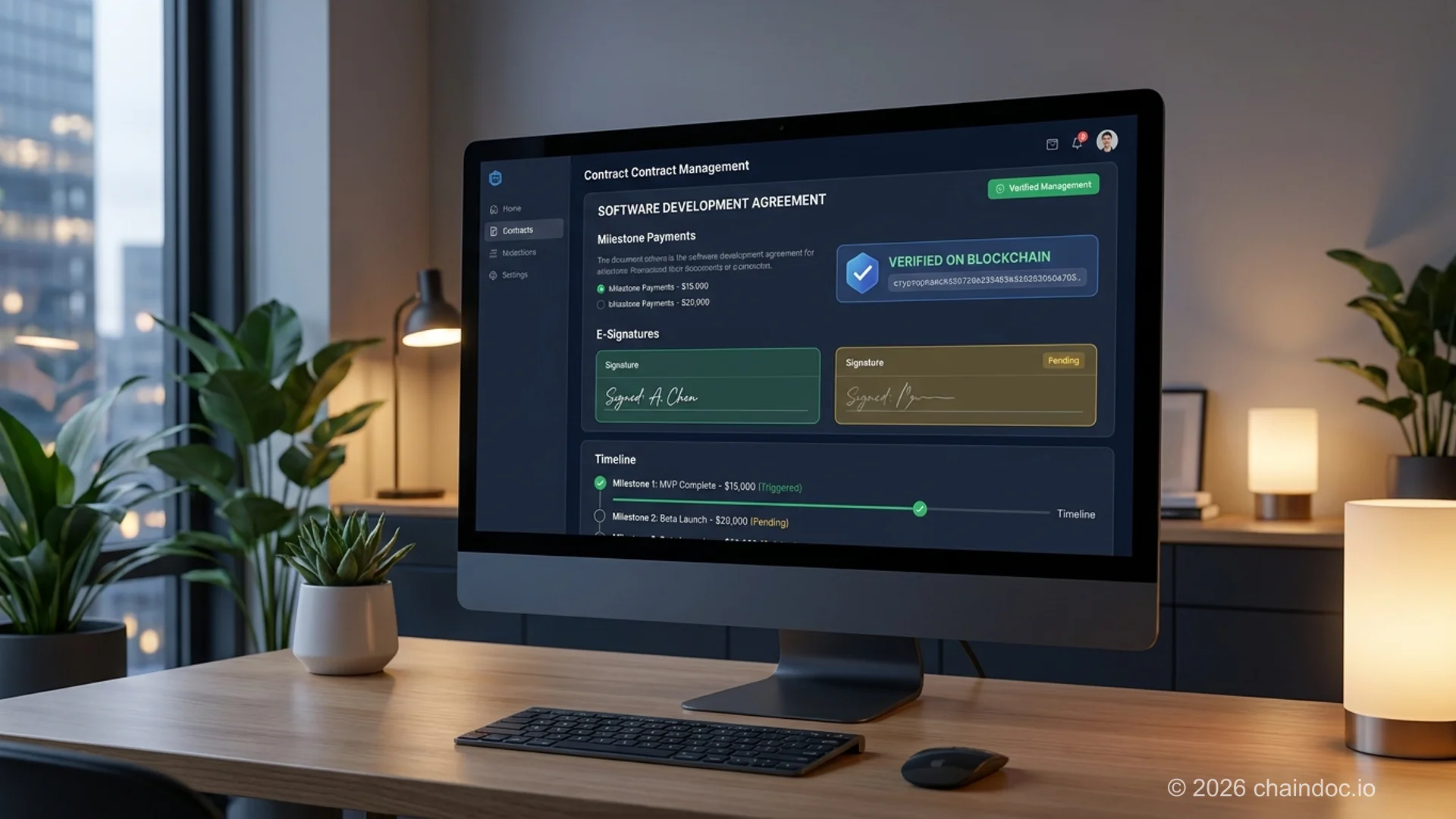
A purpose-built workflow connects SDA signature events to milestone payments, eliminating the gap between acceptance and billing.
Blockchain E-Signatures vs Traditional E-Sign Tools
| Capability | Chaindoc (Blockchain) | DocuSign / Adobe Sign |
|---|---|---|
Immutable audit trail | Cryptographic hash on public ledger | Vendor-controlled database log |
Tamper detection | Instant — any byte change breaks the hash | Manual audit, often delayed |
Legal frameworks | ESIGN, UETA, eIDAS, HIPAA, GDPR | ESIGN, UETA, eIDAS |
Identity verification | Optional KYC + on-chain signer ID | Email/SMS OTP only |
Cross-border recognition | Independently verifiable worldwide | Depends on vendor's local presence |
Pricing model | Tiers from €9/mo, no per-signature fee | Per-envelope / per-user fees |
Vendor lock-in | Records remain valid even if vendor disappears | Records depend on vendor's continued service |
Court admissibility | Strongest evidentiary tier (cryptographic + timestamped) | Standard electronic-record tier |
How to sign a software development agreement online
Getting a signed SDA used to mean printing, scanning, emailing, and hoping the other party's version matches yours. There's no good reason to do it that way anymore. Actually, organizations using automated contract management reduce cycle times by up to 50%, according to Aberdeen Group research.
What makes an electronic signature legally valid
Under the ESIGN Act (US) and eIDAS (EU), an electronic signature is legally valid for commercial agreements when it:
- Is applied by someone with intent to sign
- Is associated with the specific document being signed
- Is capable of attribution to the signer
- The record is stored in a form that can be retrieved later
Cryptographic signatures go further: each signature is mathematically bound to the document's hash. Change a single character after signing, and the hash changes, making the tampering immediately detectable. This non-repudiation makes the agreement defensible in court. Neither party can later claim the document was altered.
How the signing workflow works
Document management for IT companies typically runs multiple SDAs, SOWs, and NDAs simultaneously. A purpose-built workflow prevents the version-control nightmare that comes with email-based signing:
- Upload the finalized SDA to a contract management service
- Add each signer's email address and signing order
- Each party receives a secure signing link, no account required to sign
- Signatures are applied; the service generates a certificate of completion with timestamps, IP addresses, and the document hash
- Both parties automatically receive the fully executed document
- The audit trail is stored immutably, accessible for future reference or dispute resolution
Milestone payments tied to signing
The most useful feature in a modern contract service isn't the signature itself. It's connecting the signature to what happens next. When a developer delivers a milestone and the client signs the acceptance form, the payment trigger fires automatically. No manual invoice chasing, no "I thought you'd send the invoice separately" confusion. For teams managing contract-linked payments, this removes the gap between acceptance and billing.
For a full pricing breakdown of contract management plans, Chaindoc's pricing page covers what's included at each tier.
Industry Outlook and Further Reading
According to the eIDAS Regulation 910/2014, the U.S. ESIGN Act (Public Law 106-229), and NIST IR 8202 on Blockchain Technology, blockchain-anchored electronic signatures meet the highest tier of evidentiary requirements across major jurisdictions. Industry analysts report that organizations adopting blockchain document workflows reduce contract-cycle time by 60% and recover roughly $3,000 per team per month in administrative cost — about 4x the ROI of partial digitization.
Compare available tiers on the Chaindoc pricing page and browse more practical guides in the Chaindoc blog to find the workflow that fits your team.
Frequently Asked Questions
Answers to popular questions about Chaindoc and secure document workflows.
A software development agreement (SDA) is a legally binding contract between a client and a software developer or development company. It defines the project scope, deliverables, payment schedule, IP ownership, confidentiality obligations, acceptance testing criteria, and termination conditions. Without one, disputes over who owns the code, what was promised, and when payment is due become very difficult to resolve.
That depends entirely on what your agreement says. Under US copyright law, an independent contractor retains ownership of code they write unless there's a written assignment of rights. Paying for the work doesn't automatically transfer ownership. Your SDA needs an explicit IP assignment clause transferring copyright to the client upon payment. Pre-existing developer tools and libraries are typically licensed to the client, not assigned.
A standalone SDA is a complete contract for a single project. It covers IP, payment, warranties, termination, and scope in one document. A Statement of Work (SOW) is typically used alongside a Master Service Agreement (MSA): the MSA sets the long-term legal framework, and each SOW defines a specific project's deliverables and payment under that framework. For one-off projects, use a standalone SDA. For ongoing relationships spanning multiple projects, the MSA + SOW structure is more efficient.
An MSA (Master Service Agreement) is the baseline legal contract that governs a long-term relationship between a client and a development partner. It covers IP ownership defaults, liability limits, confidentiality, governing law, and dispute resolution. Once the MSA is signed, individual projects are documented in Statements of Work (SOWs) that reference the MSA's terms. You negotiate the MSA once rather than renegotiating core legal terms for every project.
Yes, with important caveats. A free template is a solid starting point for straightforward domestic projects. For international outsourcing, complex multi-phase builds, projects involving significant IP (especially anything with commercial licensing plans), or engagements where one party has significantly more bargaining power, have a software attorney review the IP, warranty, and limitation of liability sections before signing. The cost of a legal review is almost always less than the cost of a dispute.
More e-signature and blockchain guides
Practical guides on electronic signatures, blockchain audit trails, and secure document management — handpicked to build on what you just read.