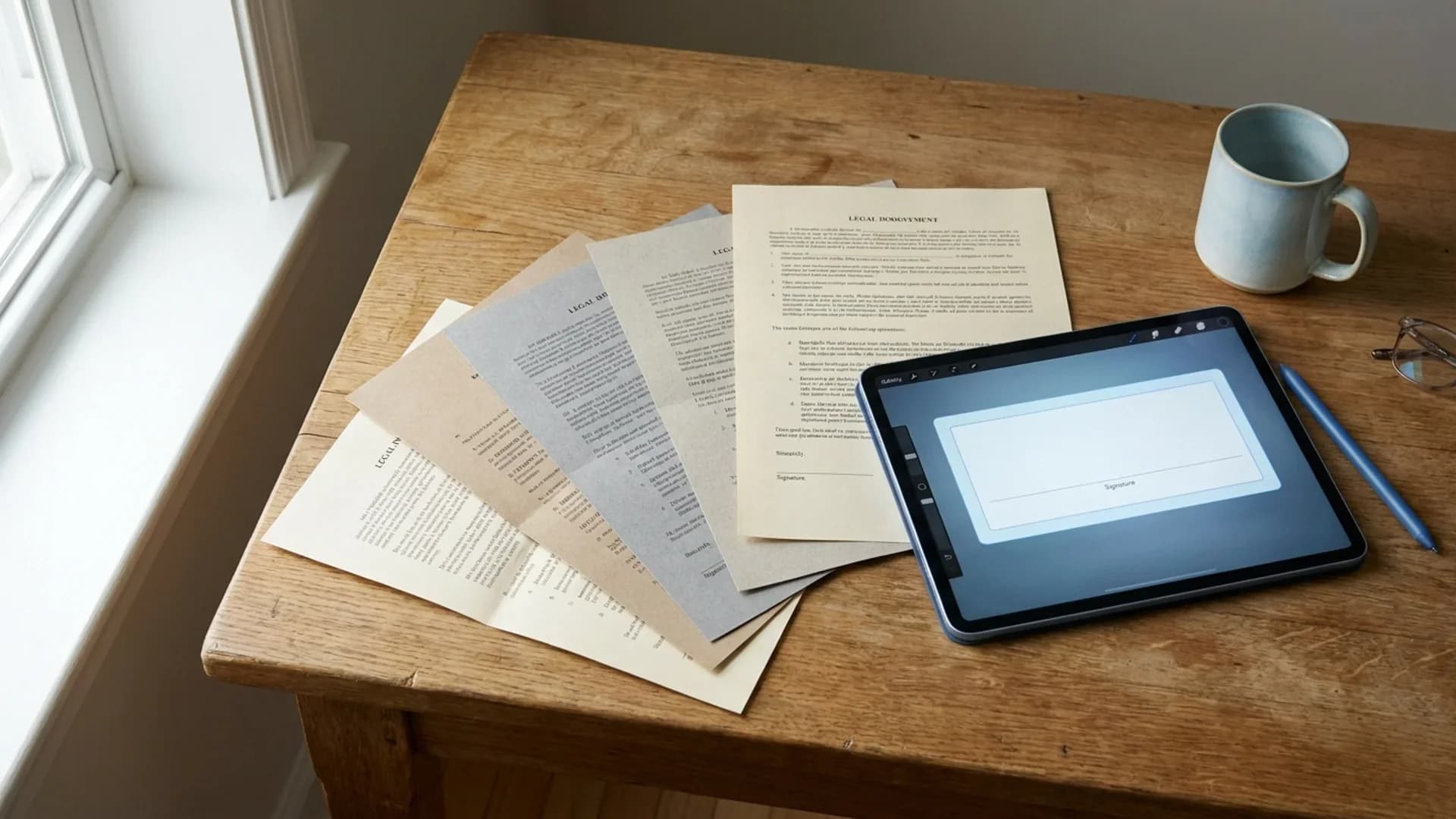
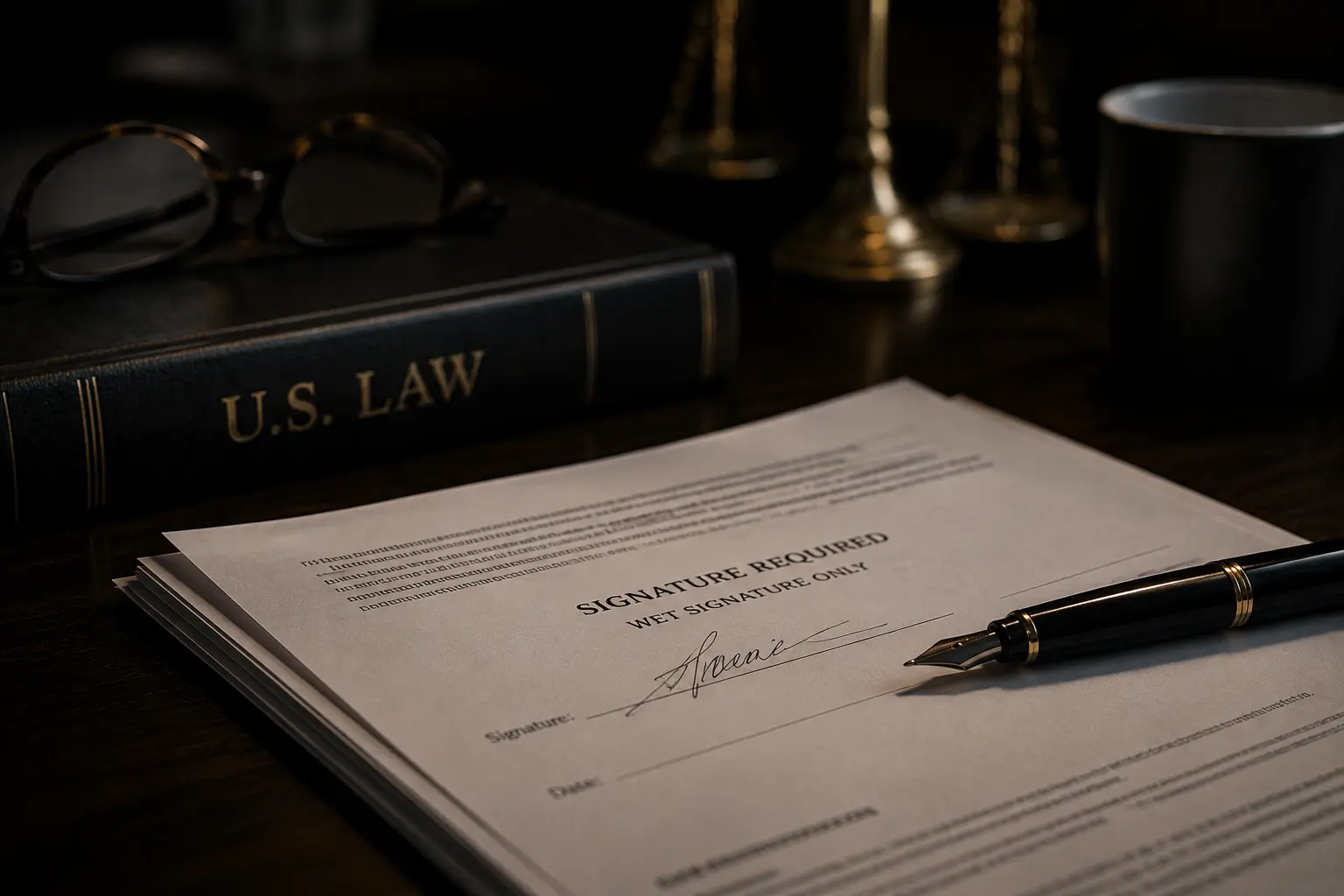
What Is a Wet Signature, and When Do You Still Need One
A wet signature is ink on paper, signed by hand. What the term means, the documents US law still requires it for, and when an electronic signature is equal.
Sign a document and check the record yourself.
Start nowIs a wet signature a legal requirement or a preference?
Someone has asked you for a wet signature. Maybe it was a bank, maybe a county clerk, maybe the other side's counsel. The request sounds official, which raises the obvious question: is this the law talking, or is it a preference?
Most of the time it is a preference.
A wet signature is a signature made by hand, in ink, on paper. The name comes from the ink being wet at the moment you sign. That is the whole idea behind the phrase. No US statute defines it, and no federal law requires one for ordinary business agreements.
This guide covers what the term means, the short list of documents where American law still insists on paper, and the widely repeated claim about three states that stopped being true years ago.
"Wet signature" is industry shorthand, not a legal term. The phrase appears nowhere in the ESIGN Act or in the Uniform Electronic Transactions Act. Both statutes speak of signatures and electronic signatures, and treat them as equal for almost every transaction.
What a Wet Signature Actually Means
A wet signature is the mark you make with a pen on a physical page. Ink, paper, your own hand. People also say wet ink signature, and the two phrases mean the same thing.
The term exists only because of the contrast. Before documents moved onto screens, nobody needed a word for signing on paper. That was simply signing.
What qualifies is broader than most people assume. Courts have accepted initials, an X, and signatures nobody could read. What matters is that a person made the mark themselves and intended it to stand for their agreement. A wet signature example can be as plain as a scrawl at the foot of a page.
The physical act carries no magic of its own. Its value shows up later, in a dispute, because the original sheet holds evidence that a copy does not: pen pressure, stroke order, indentation, the specific ink. A document examiner can work with all of that. That is the real difference, and it matters in exactly one situation, when somebody denies signing at all.
Wet Signature vs Electronic Signature: What the Law Says
The federal rule fits in a single sentence, and it repays reading in the original. Under the ESIGN Act, 15 U.S.C. § 7001(a), a signature or contract "may not be denied legal effect, validity, or enforceability solely because it is in electronic form."
The word doing the work there is solely. ESIGN removes one objection, the form. It does not rescue an agreement that would have failed for any other reason.
The same statute says what counts as a signature. Under 15 U.S.C. § 7006(5), an electronic signature is "an electronic sound, symbol, or process, attached to or logically associated with a contract or other record and executed or adopted by a person with the intent to sign the record."
Read that twice. It mentions no certificates, no biometrics, no cryptography. A typed name at the end of an email can satisfy it. What the law asks for is intent, plus a link between the signature and the record it belongs to.
Subsection 7001(b) draws the boundary from the other side. ESIGN changes no substantive rule of law beyond requirements that a contract be written, signed or in non-electronic form. If a statute demands notarization, ESIGN leaves that alone. If a court rule demands an original, ESIGN leaves that alone too.
So the honest answer on wet signature vs electronic signature is this. For an ordinary contract the two carry the same weight under federal law. The exceptions are narrow, and Congress listed them by name. If you want the separate question of how an electronic signature differs from a cryptographic one, that is covered in digital signature vs electronic signature.
When a Wet Signature Is Still Required
15 U.S.C. § 7003(a) carves specific categories out of ESIGN. These are the documents where paper still governs:
- Wills, codicils and testamentary trusts. No exception anywhere.
- Family law matters, including adoption, divorce and other domestic relations documents.
- The Uniform Commercial Code, except Article 2 on sales and Article 2A on leases, which stay inside ESIGN.
- Court documents. Pleadings, notices, motions and orders answer to court rules rather than to ESIGN.
- Certain consumer notices, listed in § 7003(b): cancellation of utility service, default or foreclosure on a primary residence, termination of health or life insurance benefits, and recall of a product that affects health or safety.
That is the federal list, and it is shorter than people expect. An NDA can be signed electronically. So can a seven-figure supply agreement.
A second category trips people up more often. Notarization, real estate recording and court filing frequently require ink, and not because of ESIGN. They require it because of state notary statutes, county recorder practice and local court rules written for paper, some of which have never been updated. ESIGN does not override them and was never meant to: they sit outside the narrow question of whether a contract must be written or signed.
This distinction is worth holding on to. When someone tells you the law requires a wet signature, the useful follow-up is which law. Nine times out of ten the answer is a county office's own procedure, not a statute.
Sign Without Printing, and Prove It Later
Chaindoc records signer identity, timestamps and a document hash for every signature, so the file you send can be checked for tampering years afterwards.
Start Signing FreeThe Three-States Myth, and What Is True in 2026
Search this topic and the same line comes back from a dozen vendor blogs: three states never adopted UETA, namely New York, Illinois and Washington. It was accurate once. It is out of date now.
- Washington repealed its Electronic Authentication Act and adopted UETA, effective 2020.
- Illinois replaced the Electronic Commerce Security Act of 1998 with its own version of UETA, effective 1 January 2022.
- New York has still not adopted it. The state runs the Electronic Signatures and Records Act, known as ESRA, under Article I of the State Technology Law.
So the count is one, not three.
Does it change the outcome? Rarely. ESRA gives an electronic signature the same force and effect as one made by hand, which is where UETA lands as well. What changes is the authority you cite. Drafting for a New York matter and quoting UETA section numbers will make a careful reader wonder what else you did not check.
How to Handle a Wet Signature on a PDF
The request usually arrives worded like this: please return a wet signature on the attached PDF. Taken literally that cannot be done. A PDF holds no ink.
What the sender wants is one of three things:
- 1.Print, sign, scan. You print the document, sign it in ink, scan it back. The signed original now lives on paper in your drawer. What you send is a photograph of it.
- 2.A drawn signature. You sign with a finger, stylus or trackpad and the software drops the drawing into the file. It looks like ink. Legally it is an electronic signature.
- 3.A signature with a record behind it, capturing signer identity, timestamps, IP address and a hash of the exact file that was signed.
Option one deserves a second thought. The moment you scan a signed page, what you are sending stops being a wet signature. It becomes an image of one, which is why the term facsimile signature exists. The evidentiary properties change with it. Nobody can measure pen pressure on a JPEG, and an image can be lifted out of one document and dropped into another in about four seconds.
That is the quiet problem with print-sign-scan. It feels more careful than signing electronically, and it usually proves less. A scanned page carries no record of who scanned it or when. A signature captured with identity checks and a tamper-evident audit trail carries both, and the recipient can verify afterwards that the file was never altered.
If someone insists on a scan of an ink signature, keep the paper. The scan is the copy; the sheet in your drawer is the evidence. Throw it away and you have given up the single advantage a wet signature had over a typed name.
Wet, Electronic and Facsimile Signatures Compared
Three things get confused with each other constantly, usually because all three end up looking like handwriting on a screen.
| Wet signature | Electronic signature | Facsimile signature | |
|---|---|---|---|
| What it physically is | Ink applied by hand to paper | A symbol or process attached to a record with intent to sign | A reproduction of a signature: scan, image, rubber stamp |
| What it proves on its own | That someone signed this exact sheet | Depends entirely on the evidence captured alongside it | Very little; the image proves only that the image exists |
| How it is challenged | Handwriting analysis of the original | Audit trail, identity checks, timestamps, document hash | Almost impossible to defend without other proof |
| Where it is accepted | Everywhere, including the § 7003 exceptions | Everywhere except the § 7003 exceptions | Where a specific statute or the parties allow it |
| Cost of one signature | Print, sign, scan, post, file | Seconds, no paper | Seconds, no paper |
The column worth studying is the second row. A wet signature and an electronic signature both prove something on their own, and a scanned image proves almost nothing on its own. Yet the scan is the one people reach for when they want to be careful.
What This Means in Practice
Three things are worth taking away.
First, the phrase carries no legal weight. When a counterparty asks for a wet signature they are usually expressing a habit, and a polite question about which requirement they are working from often ends the discussion.
Second, the genuine exceptions are listed in § 7003 and they are narrow. Wills, family law, most of the UCC, court filings and a handful of consumer notices. If your document is not on that list, federal law treats ink and electronic as equal.
Third, the reflex to print and scan works against you. It produces a file with weaker evidentiary standing than either alternative while feeling like the cautious choice. If the concern is proving later that a particular person agreed to a particular document, the answer is a record, not ink. Whether a given service actually holds up in court is a fair question, and it is the one taken apart in is DocuSign legally binding.
Frequently Asked Questions
Answers to popular questions about Chaindoc and secure document workflows.
No. Under the ESIGN Act a signature cannot be denied legal effect solely because it is electronic, so for ordinary contracts the two carry equal weight. The difference is evidentiary rather than legal: each proves what happened in a different way, through handwriting analysis on one side and an audit trail on the other.
No. Once scanned it is an image of a signature, sometimes called a facsimile signature. The paper original remains the wet signature, which is why keeping it matters. If you send only the scan and later throw the paper away, you are left with a file that carries less evidentiary value than a properly recorded electronic signature.
Yes. ESIGN sets a floor, not a ceiling. Any party is free to insist on paper as a condition of doing business, and lenders, insurers and government offices often do. It is a contractual or procedural choice on their part, not a legal requirement, and it is usually open to discussion.
Section 7003 of the ESIGN Act excludes wills, codicils and testamentary trusts, family law matters such as adoption and divorce, most of the Uniform Commercial Code apart from Articles 2 and 2A, court documents, and specific consumer notices including foreclosure and utility cancellation. Separately, many notary, recording and court-filing procedures still expect paper under their own rules.
It depends on the state. Remote online notarization is now authorised in most states, and there the signature and the notarial act are both electronic. Where it is not authorised, the requirement comes from that state's notary statute rather than from ESIGN, which explicitly leaves notarization rules untouched.
More e-signature and blockchain guides
Practical guides on electronic signatures, blockchain audit trails, and secure document management — handpicked to build on what you just read.