What is an electronic signature, and when does the law accept it?
What is an electronic signature? Read the ESIGN Act and eIDAS definitions, see which signing methods count, what the law excludes and why signatures fail.
Sign a document and check the record yourself.
Start nowWhat is an electronic signature? The legal definition
Ask a lawyer what is an electronic signature and the answer is broader than most people expect. Under the US ESIGN Act it's "an electronic sound, symbol, or process" attached to or logically associated with a record and adopted "with the intent to sign the record" (15 U.S.C. §7006(5)). A typed name counts. So does a click on "I agree", a finger-drawn mark, a code from a text message, or a certificate-based digital signature.
The EU says the same in drier words. Article 3(10) of eIDAS calls it data in electronic form, attached to or logically associated with other electronic data, which the signatory uses to sign.
Neither definition names a technology or a vendor. That's deliberate: the rule shouldn't age with the software. Two ideas sit inside both:
- Intent. Your name in an email's "To" field isn't a signature. The same name typed under "Agreed and accepted" probably is.
- Association with one record. A picture of your handwriting, emailed on its own, is attached to nothing.
Here's the part vendor pages skip. The definition tells you what counts. It doesn't tell you whether a particular signature will survive a dispute, and that's a question of evidence, which is what most of this guide is about. If someone has asked you for ink instead, the guide to wet signatures covers when paper is still required.
The same idea in four legal systems
| Where | Law | What counts | What the law promises |
|---|---|---|---|
United States, federal | ESIGN Act, 15 U.S.C. §7006(5) | An electronic sound, symbol or process attached to or associated with a record, adopted with intent to sign | No denial of legal effect solely because it's electronic (§7001(a)) |
United States, states | UETA §2(8), adopted by 49 states; New York's ESRA, State Technology Law §304 | Nearly the same wording as ESIGN | UETA: an electronic signature satisfies a law that requires a signature. ESRA: same validity as a handwritten one |
European Union | eIDAS, Regulation (EU) No 910/2014, Art. 3(10) and 25 | Data in electronic form attached to or associated with other data, used by the signatory to sign | Can't be refused legal effect or as evidence for being electronic or not qualified; a qualified one equals a handwritten signature |
United Kingdom | Electronic Communications Act 2000, s.7; Law Commission report of 2019 | Any electronic method that shows an intention to authenticate, from a typed name to a click | Admissible in evidence; capable of executing a document, including a deed |
The law protects the form, not the deal
ESIGN §7001(a) says a signature or contract can't be denied legal effect solely because it's electronic. eIDAS Article 25(1) says the same about evidence in court. Neither one makes a given signature valid. They remove one argument against it. Whether the contract binds still turns on ordinary contract law and on proof of who agreed to what.
What qualifies as an electronic signature: examples
Almost anything you do on a screen to say "I agree to this document" qualifies as an e-signature. Every method in the table below counts under ESIGN and eIDAS. What separates them is how much proof each one leaves behind.
Is typing your name an electronic signature? Yes, if you typed it to sign. The Law Commission's 2019 report notes that English courts have accepted a name typed at the bottom of an email. The weak spot is attribution, since anyone with access to your inbox could have typed it.
The scanned signature is the case people get wrong most often. Pasting an image of your handwriting into a PDF does create a signature in the legal sense. It's just a poor one: the image says nothing about who pasted it or whether page four changed afterwards.
Making one takes a minute: open the document in a signing service, type or draw your name where the field asks, and confirm. The mark is the easy bit. When you sign and send documents with Chaindoc, it's the record of who opened and signed, and when, that does the work later.
Seven electronic signature methods and what proves them
| Method | An electronic signature? | What usually proves who signed |
|---|---|---|
Typed name at the end of an email or web form | Yes, if typed with intent to sign | Control of the email account and the messages around it |
Ticking "I agree" or clicking "Accept" | Yes, a "process" in ESIGN's words | Server logs tying the click to an account and a document version |
Drawing your signature with a finger or stylus | Yes | The signing service's audit trail, not the drawing |
Pasting a scanned image of your handwriting | Technically yes | Very little. Anyone can paste an image |
Typing a one-time code sent by SMS or email | Yes | Control of that phone number or inbox at that moment |
Saying "I agree" on a recorded call | Yes in the US, where ESIGN covers a "sound" | The recording and the identity checks made on the call |
Certificate-based digital signature | Yes, and the strongest kind | The certificate, plus a hash that breaks if the file changes |
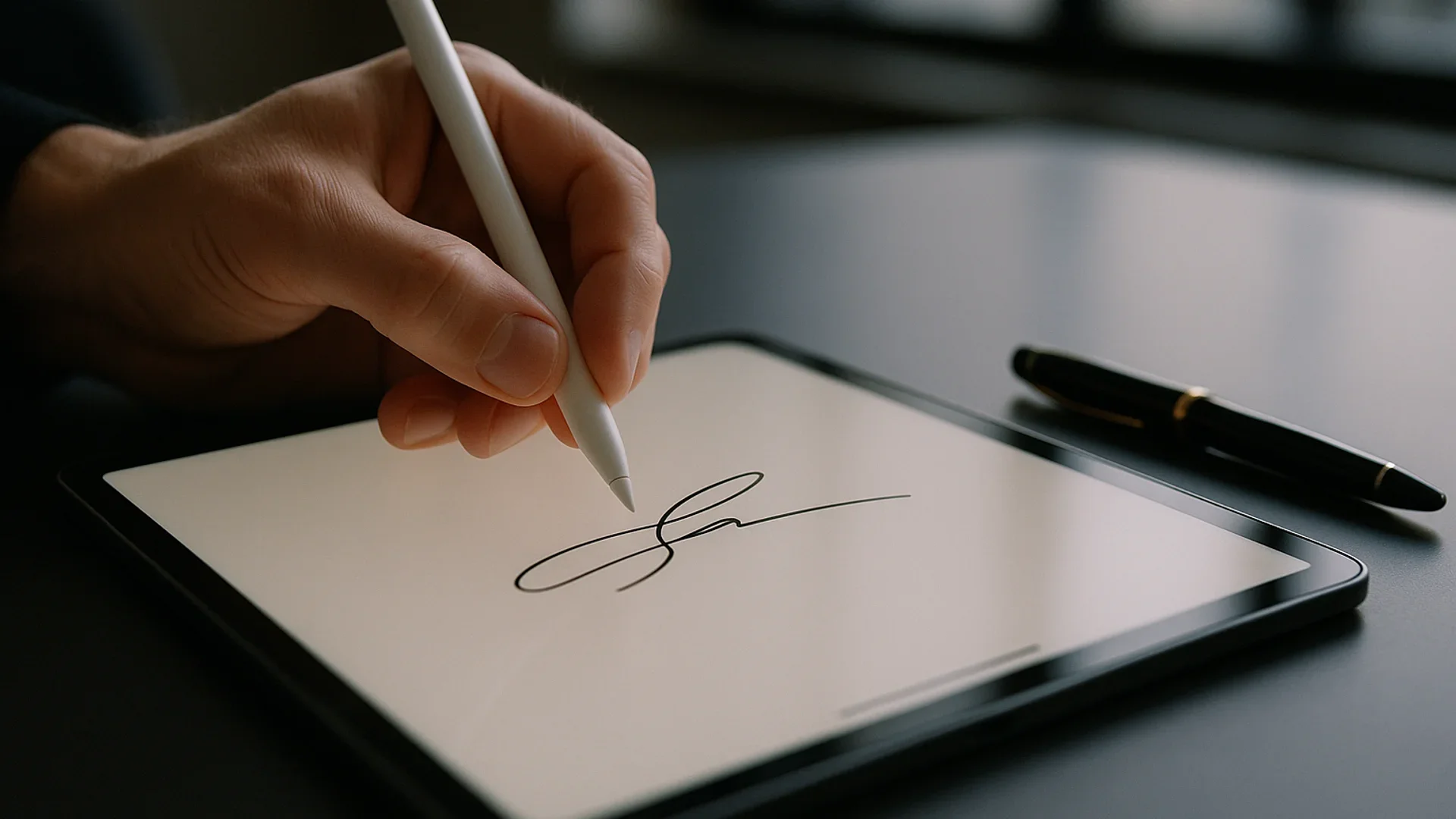
A drawn mark is the electronic signature everyone recognises. On its own, it proves the least.
What makes an electronic signature hold up
Statutes decide whether a signature is allowed. Evidence decides whether yours wins. When someone says "I never signed that", four questions come up, roughly in this order.
Intent: did they mean to sign?
The signer has to take a step that reads as agreement. A box labelled "I agree to the terms above", a button marked "Sign", a name typed under "Agreed and accepted". Silence doesn't count. Neither does a box someone else ticked in advance.
Consent: did they agree to deal electronically?
Under ESIGN, nobody has to use or accept electronic records (§7001(b)(2)). With consumers the bar is higher. Where a law says information must reach a consumer in writing, an electronic version only works after the consumer has consented, received the required disclosures and shown they can open the format (§7001(c)). Between businesses, consent usually shows through conduct. A clause in the contract is still cheaper than an argument later.
Attribution and integrity: who signed, and is it the same document?
Attribution links the signature to a person: a verified email address, a one-time code, an ID check, the IP address and device. Integrity proves the file hasn't changed since. A cryptographic hash does that job well. Change one byte and the hash comes out completely different. That's arithmetic, not a vendor promise, and anyone can rerun it.
Retention: can you still produce it?
This is the one people forget. ESIGN §7001(e) lets a court deny legal effect to an electronic record that isn't "capable of being retained and accurately reproduced" by everyone entitled to keep it. Put plainly, a signed contract that lives only inside a vendor account you've since closed is a weak contract.
In practice, intent and consent are settled by how the signing flow was built. Attribution and retention are where real disputes get lost.
ESIGN Act and UETA: the US rules
The ESIGN Act has been federal law since 2000. Its core is one sentence in 15 U.S.C. §7001(a): a signature, contract or record relating to a transaction in interstate or foreign commerce "may not be denied legal effect, validity, or enforceability solely because it is in electronic form."
The ESIGN Act requirements that trip people up fit in a short list:
- 1.Consumer consent, after specific disclosures, before electronic records replace paper ones a law says must be in writing (§7001(c)).
- 2.A record every party can keep and reproduce accurately (§7001(e)).
- 3.No forced adoption. Nobody has to accept electronic signatures without agreeing to (§7001(b)(2)), so a bank that insists on its own process is within its rights.
Below the federal layer, the states use the Uniform Electronic Transactions Act, a model law from 1999. UETA's definition in §2(8) is nearly word for word the federal one, and its §7 says that where a law requires a signature, an electronic one satisfies it.
New York is the holdout, the only state without a version of UETA. Its Electronic Signatures and Records Act does the same job: State Technology Law §304 gives an electronic signature "the same validity and effect as the use of a signature affixed by hand."
The three EU levels: simple, advanced, qualified
eIDAS, Regulation (EU) No 910/2014, sorts electronic signatures into three levels, and all three are valid. Article 25(1) bars a court from refusing one legal effect or admissibility as evidence just because it's electronic or isn't qualified. The levels decide how much you'll have to prove, not whether you may sign.
An advanced electronic signature meets the four conditions of Article 26: it's uniquely linked to the signatory, capable of identifying them, created with data they can use under their sole control, and linked to the signed data so any later change is detectable.
A qualified signature adds a qualified signature creation device and a qualified certificate. It's the only level the regulation puts on a par with ink (Article 25(2)), and every member state recognises one issued in another (Article 24a, which replaced the old Article 25(3) in 2024). How you get one, and whether it's worth the cost, is in our guide to qualified signatures.
eIDAS levels side by side
| Level | Legal test | Legal effect | Typical use |
|---|---|---|---|
Simple | Any data the signatory uses to sign (Art. 3(10)) | Valid and admissible; you prove what happened if it's disputed | NDAs, sales orders, HR forms, most B2B contracts |
Advanced | The four conditions of Art. 26 | Valid; stronger evidence of who signed and that nothing changed | Higher-value and cross-border contracts, regulated onboarding |
Qualified | Advanced, plus a qualified creation device and a qualified certificate (Art. 3(12)) | Equal to a handwritten signature (Art. 25(2)); recognised in every member state (Art. 24a) | Documents where national law demands written form, such as Germany's §126a BGB |
Electronic signatures in the UK
The UK kept its own copy of eIDAS after Brexit, but its basic rule is older. Section 7 of the Electronic Communications Act 2000 makes an electronic signature admissible in evidence on questions of authenticity and integrity. In 2019 the Law Commission went further and concluded that one "is capable in law of being used to execute a document (including a deed)", as long as the signer means to authenticate it. One catch survives. A deed still needs a witness physically present when it's signed, even if everyone signs on a screen.
Where digital signatures and non-repudiation fit
People use "electronic signature" and "digital signature" as if they meant the same thing. They don't.
An electronic signature is the legal idea: someone's intent to be bound, expressed electronically. A digital signature is one technique for producing it. The signer's software uses a private key, backed by a certificate from a certificate authority, to sign a hash of the document. Anyone holding the public key can then check which certificate signed and whether the file has changed since.
That pairing is what security people call non-repudiation: the signer can't credibly deny the signature, because the proof travels inside the file rather than in somebody's database. Strictly, it proves the key was used. Whether the right person held the key is still a question of fact.
Every digital signature is an electronic signature. Most electronic signatures aren't digital, and for ordinary contracts the law doesn't ask them to be. The full comparison of digital and electronic signatures covers the technical side.
Signing is the easy part. Keep the record
Chaindoc records who signed what and when, writes each published version's hash to a public blockchain, and exports the audit trail as a PDF you keep. The free plan covers five signatures a month, no card needed.
See how signing worksDocuments you can't sign electronically
E-signing covers nearly every commercial document. The exceptions are short, specific and local, which is exactly why they catch people out.
In the US, 15 U.S.C. §7003 takes these out of ESIGN's general rule:
- Wills, codicils and testamentary trusts
- Adoption, divorce and other family-law matters
- Most of the Uniform Commercial Code (Articles 2 and 2A, on sales and leases, stay in)
- Court orders, notices and official court papers such as briefs and pleadings
- Notices cutting off water, heat, power or other utility service
- Default, foreclosure or eviction notices on someone's primary residence
- Notices cancelling health insurance or life insurance benefits
- Product recalls where health or safety is at risk
- Papers that must travel with hazardous materials, pesticides or other toxic goods
Excluded from ESIGN doesn't automatically mean paper. It means federal law stops guaranteeing the electronic version and state law or the court's own rules take over.
Europe has its own sharp edges, and Germany shows them well. Under §126a of the German Civil Code (BGB), an electronic document replaces a statutory written form only with the issuer's name and a qualified electronic signature. And §623 BGB, on ending employment by notice or agreement, says flatly that the electronic form is excluded. No signature level helps there. Paper, or nothing.
Why an electronic signature gets rejected
A rejected signature is rarely a forged one. Usually it's a mismatch between what you sent and what the other side, or the law, needed.
Wrong level. The recipient needed a qualified signature, typically because national law requires written form, and you sent a simple one. Resending won't fix that; you need a certificate from a qualified trust service provider.
No agreement on the method. Nobody has to accept your signing process unless they've agreed to it, and banks, insurers and public bodies often specify their own.
The file changed after signing. Flattening a PDF, adding a comment or re-saving it in another editor can all break the hash.
The record can't be produced. If you can't hand over a copy every party can keep and reproduce, §7001(e) gives the other side an argument.
An expired or revoked certificate. A signature made while the certificate was valid can still stand, but proving that later takes evidence of when it was made.
A worked example
A supplier sends a signed framework agreement. Legal opens it, adds a comment, saves, and forwards it to finance. Finance runs it through a validator and gets a failure. Panic follows.
Nothing was forged. The comment rewrote the file, so its hash no longer matched the one captured at signing, and the validator did exactly what it should. The original was fine; the copy wasn't. If you're not sure which copy you're holding, a PDF signature check tells you whether the signature still matches the file.
Never re-save the signed original
Opening a signed PDF in an editor and saving it, even with no visible change, can rewrite the file and break the signature. You can't undo that on the copy you saved. Archive the original exactly as it arrived, make it read-only, and do your reading and annotating on a duplicate.
What is an electronic signature worth without a record?
Not much, honestly. So what is an electronic signature, once the legal language is stripped away? A label for intent that the law accepts readily and a court weighs on the evidence behind it.
That's the standard to hold a signing tool to. Judge it by the record it leaves, not by how the signature looks:
- A timestamped signing audit trail: who opened, signed or declined, with email and IP for each step
- A hash of the file, so a later change shows
- An export you can keep, in a format that opens without the vendor's app
- Storage that lasts as long as the retention period for that document, not as long as your subscription
Here's what Chaindoc does, since you're reading this on our blog. It hashes each file when you upload it. When you publish a document, that version's hash goes onto a public blockchain, and each signer's proof is recorded when signing completes. The audit trail and a verification report both export as PDF, and files travel over TLS. A normal request invites everyone at once; a fixed signing order comes through approval routes on the Business plan.
None of that changes the law. It changes what you can show when someone asks.
Agree the method before anyone signs
The cheapest protection against a rejected signature is one clause: the parties agree that electronic signatures, made the way you'll actually make them, bind them. It answers the consent question and the "which method" question in one go. If you work from contract templates, add it to the boilerplate once and stop thinking about it.
Sources checked for this guide
We read each page on 14 October 2026. Statutes change, so confirm the current text before you rely on it for a specific document.
- 1.15 U.S.C. §7001, General rule of validity (ESIGN Act) · U.S. Government Publishing Office, govinfoGeneral rule, consumer consent (c), no duty to accept (b)(2), retention (e); checked 2026-10-14
- 2.15 U.S.C. §7003, Specific exceptions · U.S. Government Publishing Office, govinfoThe list of documents outside ESIGN's general rule; checked 2026-10-14
- 3.15 U.S.C. §7006, Definitions · U.S. Government Publishing Office, govinfoDefinition of "electronic signature" in paragraph (5); checked 2026-10-14
- 4.Uniform Electronic Transactions Act · Uniform Law CommissionThe 1999 model act the states adopted; checked 2026-10-14
- 5.UETA and ESRA: New York electronic transactions law · New York City Bar AssociationNew York is the only state without a version of UETA; the other 49 have one; checked 2026-10-14
- 6.New York State Technology Law §304, Use of electronic signatures · New York State SenateAn electronic signature has the same validity and effect as a handwritten one; checked 2026-10-14
- 7.Regulation (EU) No 910/2014 (eIDAS) · EUR-Lex, Publications Office of the EUArticles 3(10)-(12), 24a, 25 and 26, as amended by Regulation (EU) 2024/1183; wording of 3, 25 and 26 checked on the legislation.gov.uk copy, 2026-10-14
- 8.Electronic Communications Act 2000, section 7 · legislation.gov.ukElectronic signatures admissible in evidence on authenticity and integrity; checked 2026-10-14
- 9.Electronic execution of documents (Law Com No 386) · Law Commission of England and WalesAn electronic signature can execute a document, including a deed; witnesses must be present; checked 2026-10-14
- 10.BGB §126a, Elektronische Form · Federal Ministry of Justice, gesetze-im-internet.deElectronic form replaces written form only with a qualified signature; checked 2026-10-14
- 11.BGB §623, Schriftform der Kündigung · Federal Ministry of Justice, gesetze-im-internet.deElectronic form excluded for ending employment; checked 2026-10-14
Frequently Asked Questions
Answers to popular questions about Chaindoc and secure document workflows.
Yes, if you typed it intending to sign. US law treats any symbol or process adopted with intent to sign a record as an electronic signature, and a typed name fits. In England, the Law Commission's 2019 report notes that courts have accepted a name typed at the bottom of an email. The weak point is proof: a typed name says nothing about who typed it, so keep the emails or logs around it.
Any electronic step that shows you agree to a specific record. A typed name, a click on "I agree", a drawn signature, a one-time code or a certificate-based digital signature all qualify, as long as there's intent to sign and a link to the record. How well each one holds up is a separate question, and it depends on the evidence the method leaves behind.
Usually, yes. The ESIGN Act and UETA in the US, eIDAS in the EU and the Electronic Communications Act in the UK all stop a signature being rejected just because it's electronic. That doesn't make every one binding. The contract still needs its usual ingredients, and you need evidence of who signed and that the document hasn't changed since. A short list of documents, including wills, some family-law matters, court papers and certain consumer notices, sits outside the general rule in the US, and other countries keep their own lists.
Less than people expect, and no particular technology. It requires consumer consent, after set disclosures, before electronic records replace paper ones a law says must be in writing (§7001(c)). The signed record has to be one every party can keep and reproduce accurately (§7001(e)). And nobody is forced to accept electronic signatures without agreeing to (§7001(b)(2)).
It's the middle of the three EU levels. Under eIDAS Article 26 it must be uniquely linked to the signatory, capable of identifying them, created with data they control, and linked to the signed data so any later change shows. It weighs more as evidence than a simple signature, but only a qualified one is formally equal to handwriting.
More e-signature and blockchain guides
Practical guides on electronic signatures, blockchain audit trails, and secure document management — handpicked to build on what you just read.